Dorfkirche Ludorf, Gothic brick church in Ludorf, Germany
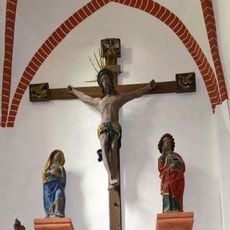
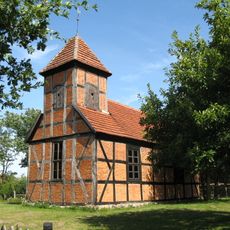
Dorfkirche Ludorf is a brick church in the Gothic style with an unusual octagonal floor plan and four extensions. The interior features ribbed vaulting that creates a distinctive ceiling structure and defines the space throughout.
The brick church was first documented on 8 May 1346, when Bishop Burchard of Havelberg consecrated its main building to St. Mary and St. Lawrence. Legend holds that a crusader of the local Wip(p)ert von Morin family founded it some 150 years earlier, modelled on the Church of the Holy Sepulchre in Jerusalem. The west extension is the base of a tower that collapsed during the Thirty Years' War.
The north chapel holds the burial vault that Adam Levin von Knuth had built for himself and his wife in 1736; nine coffins and a child's coffin stand behind an oak door with a wrought-iron grille. The south chapel, open to the central room, was the patron's box during services. The bell Beata, cast in 1911, is named after its donor Beate von Bülow.
The main entrance is the west portal, leading through the porch into the central octagonal room. The church is a branch of the Röbel parish, and concerts are held there regularly. Restoration work on the porch and outer walls took place in 1996/97 with support from the German Foundation for Monument Protection, and the church was rededicated in 2001.
The floor plan mirrors the design of the Church of the Holy Sepulchre in Jerusalem, making this building a rare architectural example in Northern Germany. This reflection of a distant sacred site was an unusual choice for a small village church.
The community of curious travelers
AroundUs brings together thousands of curated places, local tips, and hidden gems, enriched daily by 94,639 contributors worldwide.