Drachenlochbrücke, Arch road bridge in Baden-Württemberg, Germany.
The Drachenlochbrücke is a reinforced-concrete arch bridge on the A8 at the Drackensteiner Hang, the first of three large bridges there. It has ten arches with spans of 15.6 metres and pier spacing of 18.5 metres, and its 9-metre-wide deck carries two lanes in the descent toward Stuttgart, right after the Nasenfelstunnel and the Impferlochbrücke.
The structure was built in 1936 based on a design by prominent architect Paul Bonatz to cross the valley. It was destroyed in 1945 during World War II and had to be reconstructed between 1949 and 1950.
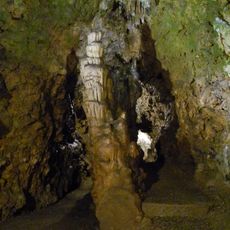
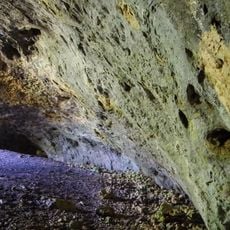
The name Drachenlochbrücke refers to the nearby Drachenloch, a cave whose name links the bridge to a dragon legend; the sources do not record the tale itself. The bridge stands with the Himmelsleiterbrücke and Fischerhäuslebrücke as a protected ensemble on the Drackensteiner Hang. Its ten 15.6-metre arches and 18.5-metre pier spacing, designed by Paul Bonatz, are visible from the valley.
The bridge carries the two-lane downhill carriageway of the A 8 towards Stuttgart, directly after the Nasenfelstunnel and the Impferlochbrücke. The road built on the mountainside as a wartime detour later served as a car park; its access is now closed. The A 8 between Mühlhausen and the Widderstall car park is planned to be rerouted with six lanes and new tunnels.
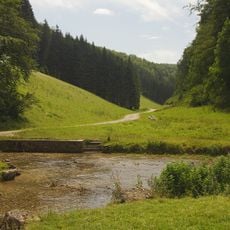
The bridge was blown up by the German Wehrmacht shortly before the end of the Second World War to slow the Allied advance. Its debris still lies in the Gosbach valley today, and the whole complex, including the Drachenlochbrücke, the Himmelsleiterbrücke and the Fischerhäuslebrücke, is a protected monument.
The community of curious travelers
AroundUs brings together thousands of curated places, local tips, and hidden gems, enriched daily by 93,614 contributors worldwide.