Epiphaniaskirche, Protestant church in Feudenheim, Mannheim, Germany
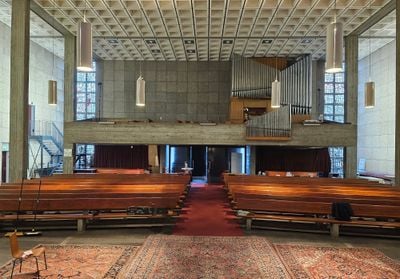
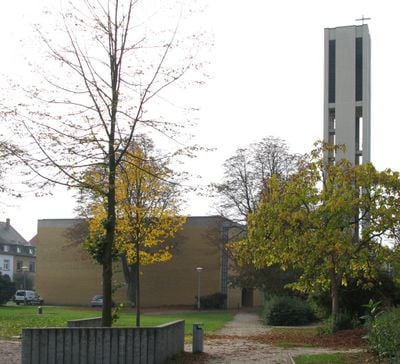
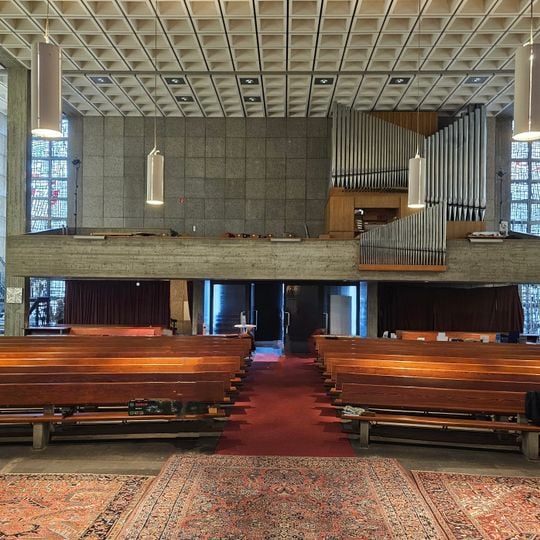
The Epiphaniaskirche is a cubic, yellow-brick church set back between a 28.5-metre concrete bell tower and a parish hall in north-west Feudenheim. Its plain front has vertical bands of windows, while the side walls are windowless. Inside, supports divide the worship space into three aisles, and the altar wall is dissolved into concrete honeycombs filled with blue glass, designed by Emil Kiess.
The Epiphaniaskirche was built between 1963 and 1965 to designs by Mannheim architects Albrecht Lange and Hans Mitzlaff, after the Protestant congregation in Feudenheim grew from 2,304 members in 1887 to 6,647 in 1939. A plot was bought in 1935 and a competition held in 1939, but World War II halted the plans. The foundation stone was laid on 3 November 1963, the bells arrived in 1964, and the church was inaugurated on 7 March 1965. In 2007 the two Feudenheim parishes merged again.
The church is named after Epiphany, the feast of the manifestation of the Lord. Since 2007 the two Feudenheim parishes have been reunited, and services continue in the building. Two local associations campaign to keep it as the Kulturkirche Epiphanias.
The church stands in the northwest of Feudenheim, set back between the bell tower and the parish hall, with the tower's dark doorway near its base. The site is reached on foot through the residential streets of the district. Services still take place in the actively used church, and two local associations work for its preservation as the Kulturkirche Epiphanias.
The church keeps a sculpture most visitors miss: the "Sternkreuz" (Star Cross), forged by metalworker Christian Traubel in the 1980s for the Mannheim branch of the Landeszentralbank. When that branch closed, the bank gave the piece to the Epiphanias congregation, and it was mounted on the wall in 2008.
The community of curious travelers
AroundUs brings together thousands of curated places, local tips, and hidden gems, enriched daily by 94,142 contributors worldwide.