Hauptfriedhof Mannheim, Cemetery in Wohlgelegen, Mannheim, Germany
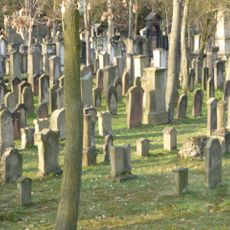
Hauptfriedhof Mannheim is a large cemetery featuring numerous pathways, ornate graves, and memorials set within landscaped gardens and wooded areas. The layout includes different sections organized by burial type and community, creating a structured space that feels both respectful and accessible.
The Mannheim city council decided on 27 April 1840 to create a new cemetery replacing the confessional graveyards in the city centre; the foundation stone was laid on 13 April 1841 and the cemetery opened on 14 July 1842. Starting from 3.2 hectares, it was enlarged in 1856, 1871, 1881, 1892, 1900, 1937 and finally 1965 to its present 34.4 hectares. The Roman numerals of the burial fields I to VIII mark each extension, laid out in the styles of their periods.
The cemetery was laid out together with an adjacent Jewish cemetery, both established at the same time. Grave fields carry Roman numerals I to VIII, each marking a phase of expansion and laid out in the style of its era. Among those buried here are Friedrich Engelhorn, founder of BASF, and the actor Albert Bassermann.
The grounds are easy to explore on foot, with clearly marked pathways and areas open to visitors. If you are looking for specific graves or need information about burials, it is worth checking what records or assistance are available beforehand.
The cemetery holds graves of figures such as Friedrich Engelhorn, founder of BASF, and August von Kotzebue, whose murder in 1819 led to the Carlsbad Decrees. Karl Ludwig Sand, his assassin, is also buried here. The old crematorium, built 1899–1900 as an ancient-style temple of light sandstone, was one of Germany's first and now serves as an urn hall.
The community of curious travelers
AroundUs brings together thousands of curated places, local tips, and hidden gems, enriched daily by 93,726 contributors worldwide.