Herzogenriedpark, Public park in Neckarstadt, Mannheim, Germany
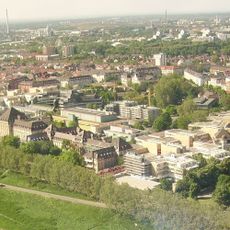
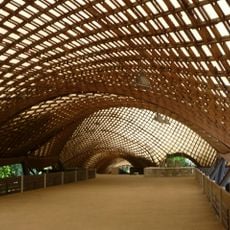
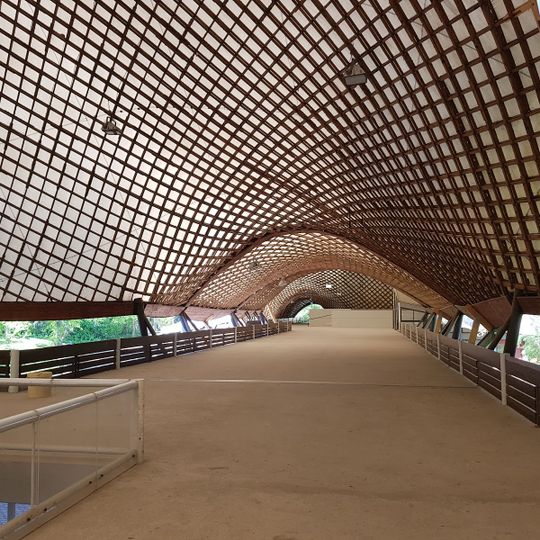
Herzogenriedpark covers 22 hectares in Mannheim's Neckarstadt-Ost district, south of the Herzogenried housing estate. Its chestnut avenue, laid out in the 1930s, still runs through the grounds. The park holds a rosarium with 100,000 roses, a park lake, a Kneipp basin, a model farm garden and the Multihalle, a wooden lattice shell built for the 1975 Bundesgartenschau.
The site was first recorded in a 1396 rent book as land of the Count Palatine in the Mannheim Ried. The city bought the plot in 1923, developed it from 1928 and opened it as a park in 1934, when the chestnut avenue was planted. In 1975 it shared the Bundesgartenschau with Luisenpark, linked by the Aerobus suspension railway.
The park's name refers to the Herzogenried settlement north of it, and its chestnut avenue, laid out in the 1920s, still shapes the grounds. Visitors can watch boule, chess and table tennis players, and children use the water playground, rope circus and petting zoo. The Rosarium holds 100,000 roses.
The park lies in Neckarstadt-Ost, south of the Herzogenried housing estate, about a kilometre from Mannheim's centre. The 22-hectare grounds are entered on foot; the chestnut avenue planted in the 1930s runs through the park. The Multihalle, the rose garden and the animal enclosure are the main fixed points for orientation.
The park's Multihalle, built for the 1975 Bundesgartenschau, is still the world's largest timber grid shell; architects Carlfried Mutschler, Joachim Langner and Frei Otto designed its multi-curved lattice of wooden slats. During the show an Aerobus suspended railway shuttled visitors between Herzogenriedpark and Luisenpark.
The community of curious travelers
AroundUs brings together thousands of curated places, local tips, and hidden gems, enriched daily by 93,850 contributors worldwide.