Kurpfalzbrücke, Road and girder bridge in Mannheim, Germany
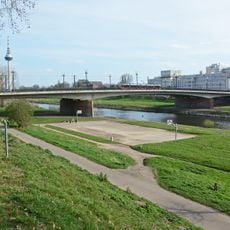
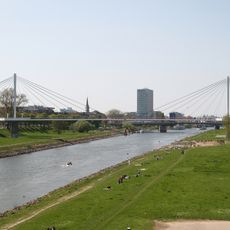
The Kurpfalzbrücke is a road bridge with a steel girder structure that crosses a waterway in Mannheim and allows traffic to move between neighborhoods. The construction uses steel beams to carry the weight of daily traffic and provides a direct crossing for vehicles.
A ferry bridge of moored boats stood about 150 m downstream from 1688; by 1841 it carried 23 boats and a 6 m roadway. A chain bridge built 1842–1845 by engineer Lüttich spanned 185.60 m on two pylons and cost 372,000 guilders, recovered through tolls on non-residents. Its successor, the Friedrichsbrücke, opened on 29 September 1891; the Wehrmacht blew it up on 25 March 1945. MAN Gustavsburg built the Kurpfalzbrücke for 3.8 million Reichsmark, inaugurated on 31 August 1950.
The name Kurpfalzbrücke, chosen at its 1950 opening, refers to the historical Electorate of the Palatinate and to a tradition of bridge names in Mannheim. The crossing links the Alter Meßplatz on the Neckarstadt side with the Kurpfalzkreisel, where the road continues into Luisenring and Friedrichsring and straight ahead into the Breite Straße pedestrian zone.
The bridge serves as a major traffic route used by many vehicles daily. Visitors exploring the area will notice it as a clear landmark in the city's road network and can cross it on foot or observe its industrial structure from nearby viewpoints.
The bridge was built using steel girder techniques that were modern and noteworthy for the 1950s. This construction method was an innovative solution at the time for safely spanning long distances and continues to define the structure's appearance today.
The community of curious travelers
AroundUs brings together thousands of curated places, local tips, and hidden gems, enriched daily by 94,515 contributors worldwide.