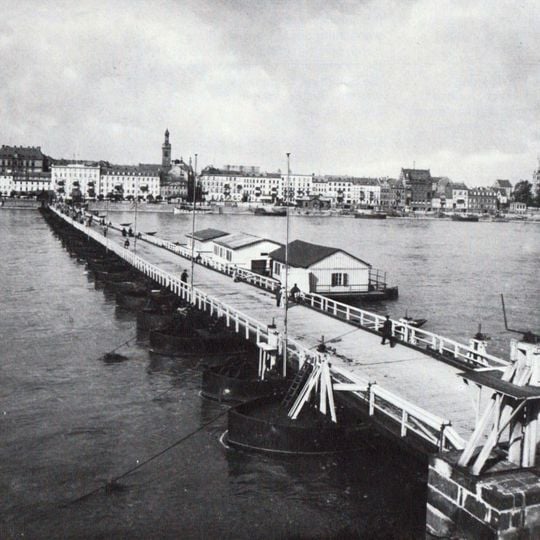
Floating bridge in Koblenz, Former pontoon bridge site in Koblenz, Germany
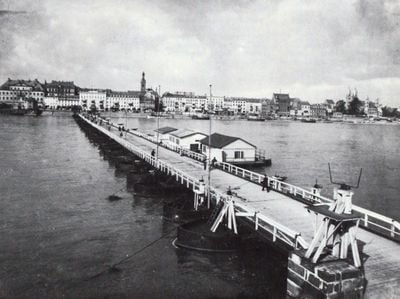
The Schiffbrücke in Koblenz was a floating bridge of 36 wooden, later iron pontoons carrying a straight deck about 7.30 metres wide and 346 metres long across the Rhine. Twelve movable bays could be opened for ships. Two white gabled bridge houses and a basalt-lava bridgehead survive in the Rheinanlagen; the bridge itself was destroyed in 1945.
A Prussian pontoon bridge opened on 18 April 1819, built by the Stinnes brothers for about 36,000 thalers with 38 wooden boats and a 346-metre curved deck. A storm damaged it in 1841, after which it was rebuilt straight with 36 boats; iron pontoons replaced the wooden ones after 1900. German troops destroyed it in March 1945, and a US replacement later sank in a flood.
The bridge gave its name to the Schängel ferry that now crosses the Rhine at the same spot. The two bridge houses in the Rheinanlagen, built before 1914 to plans by city architect Friedrich Neumann, were where the bridge toll was collected; soldiers crossed free of charge. A memorial plaque beside them recalls the Schiffbrücke Koblenz–Ehrenbreitstein, 1819–1945.
The bridge no longer exists; only the two bridge houses and the left-bank bridgehead survive in the Rheinanlagen at Konrad-Adenauer-Ufer in Koblenz-Altstadt. Visitors can find them in front of the Koblenzer Hof, with a memorial plaque beside them. The site is freely accessible at any time.
The bridge's two surviving toll houses in the Rheinanlagen, built before 1914 to plans by city building officer Friedrich Neumann, are mirror-symmetrical, with porches on pillars and flared roofs. A memorial plaque beside them records the span 1819–1945 and its 36 wooden, later iron pontoons. The basalt lava bridgehead on the left bank also survives and is a protected monument.
The community of curious travelers
AroundUs brings together thousands of curated places, local tips, and hidden gems, enriched daily by 92,802 contributors worldwide.