Schloss Krauchenwies, Neoclassical château in Krauchenwies, Germany
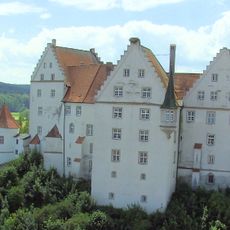
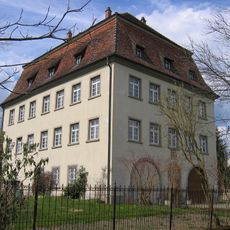
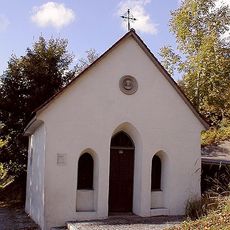
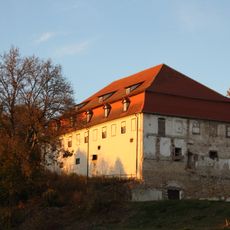
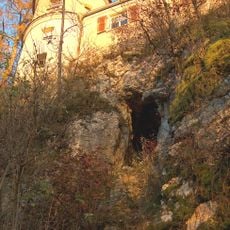
Schloss Krauchenwies is a two-storey, three-winged early Neoclassical building with hipped roofs, arranged in an irregular horseshoe shape. It stands at the southeast corner of the Fürstlich Hohenzollerischer Park on Bundesstraße 311 toward Sigmaringen. The rounded west wing holds a chapel with a bell turret, and the kitchen adjoined it to the north. The east wing was extended south during the remodeling.
The site began as a medieval moated castle, first documented in 1303 as a tower of the Leiterberg family, lords of Krauchenwies, and called a Wasserhaus in 1414. Hans Waldner rebuilt it from 1595 to 1597 as a Renaissance palace for Count Karl II of Hohenzollern-Sigmaringen; Swedish troops under General Horn destroyed it in March 1633. Prince Karl Friedrich had it remodelled between 1769 and 1785 into the present early Neoclassical three-winged building.
The castle served as a summer residence for the local ruling family, reflecting how Hohenzollern nobility lived and spent their leisure time. You can walk through rooms that once hosted the family during their seasonal stays in the region.
The castle sits right along a main road, making it easy to reach but also meaning some traffic noise is present. The surrounding park provides space to walk around and explore the exterior of the building from different angles.
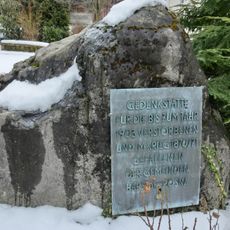
In April 1941 the 19-year-old Sophie Scholl from Ulm began her six-month Reich Labour Service at the castle, then civil labour camp 501 Krauchenwies; her rejection of National Socialism grew during this service. From 1979 to 1981 the building housed Vietnamese refugees, and in 2001 the Hohenzollern house applied to demolish it, which the public rejected.
The community of curious travelers
AroundUs brings together thousands of curated places, local tips, and hidden gems, enriched daily by 93,648 contributors worldwide.