Erbprinzenpalais, Neoclassical palace building in Wiesbaden, Germany.
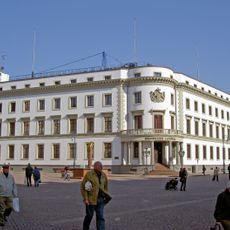
The Erbprinzenpalais is a Neoclassical building on Wilhelmstraße in Wiesbaden, erected from 1813 to 1817 to designs by city architect Christian Zais. Its facade is dominated by a broad central gable above the main axis, and the block is kept plain, with restrained ornament rather than columns or sculpture. It is the only surviving one of Zais's three Neoclassical buildings in the city.
Christian Zais built the palace from 1813 to 1817 for Wilhelm, heir of the Nassau dukes. Wilhelm moved out before it was finished: his father Friedrich Wilhelm died in January 1816 after falling down a staircase at Schloss Weilburg, and when Duke Friedrich August died that March, the 23-year-old Wilhelm became duke and moved to Schloss Biebrich. The building then became an administrative seat.
The building once housed major collections and library materials that shaped cultural life in Wiesbaden. Its rooms served the city as a repository for knowledge and artistic treasures for over a century.
The palace stands at Wilhelmstraße 24, directly opposite the green space of the Warmen Damm. It has served as the Wiesbaden Chamber of Industry and Commerce since 1968, when the chamber bought it from the city for 1.2 million marks. It is a working administrative building, so visitors should expect access to be limited to the exterior and the entrance area.
Christian Zais created one of his final classical works with this building, marking a shift away from baroque ornamentation. This restrained design approach was relatively novel for the era and distinguishes it among other structures in the city.
The community of curious travelers
AroundUs brings together thousands of curated places, local tips, and hidden gems, enriched daily by 93,906 contributors worldwide.