Villa Clementine, Literary center in Wiesbaden, Germany
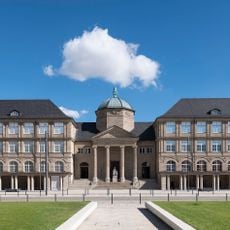
Villa Clementine is a mansion in Wiesbaden built between 1878 and 1882 with Roman and Pompeian architectural elements integrated throughout its structure. Located at the corner of Wilhelmstraße and Frankfurter Straße, the building contains several rooms including the Blue Salon and features a garden with terraces.
Built 1878–1882 by architect Georg Friedrich Fürstchen for Mainz industrialist Ernst Meyer, the villa is named after his wife Clementine, who died shortly before completion. In 1888 it was the scene of the Wiesbaden Prinzenraub, when Queen Natalie of Serbia's son was abducted. The city bought it in 1960; after demolition plans for a metro station were dropped, it became a cultural venue in 1973.
The villa is named after Clementine Meyer, wife of builder Ernst Meyer, who died shortly before its completion. Today it houses the Wiesbadener Presseclub and a literature centre, and public bookcases stand in the Blue Salon of the upper-floor café and in the garden.
The villa stands at the corner of Wilhelmstraße and Frankfurter Straße. The café on the upper floor and its Blue Salon, plus the garden, hold public bookcases that can be browsed during a visit. The building is used for events and as a literature house, so rooms may be closed during a function.
In 1978 the villa served as a filming location for an eleven-episode television adaptation of Thomas Mann's Buddenbrooks. This connection to the famous novel shows how the building's architecture itself contributed to bringing a literary world to the screen.
The community of curious travelers
AroundUs brings together thousands of curated places, local tips, and hidden gems, enriched daily by 93,359 contributors worldwide.