Warmer Damm, Public park and cultural heritage monument in central Wiesbaden, Germany
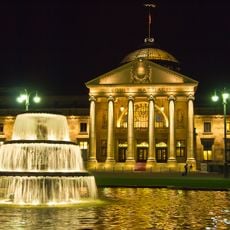
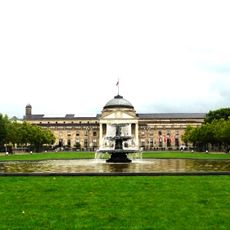
Warmer Damm is a park laid out from 1859 as an English landscape garden by garden director Carl Friedrich Thelemann, on the edge of Wiesbaden's historic pentagon. Its northern edge is closed by the Hessian State Theatre, opened in 1894 in Neo-Renaissance style with a blind portal. The grounds hold a pond with a fountain since 1988, a playground, chess tables and several large sculptures installed since the 1980s.
The name comes from a dam that bordered the Warme Weiher, a pond collecting outflow from 26 thermal springs and used as a horse watering place; it was filled in 1805. From 1859, garden director Carl Friedrich Thelemann designed the park as an extension of the Kurpark. The State Theatre was built 1892–1894, and car parks in the 1960s took a quarter of the original grounds.
The name comes from a dam that bounded the Warme Weiher, a pond collecting outflow from Wiesbaden's 26 thermal springs and used as a horse bathing pool; it was filled in 1805. Since 1980 large sculptures have been placed in the park, and each June the Wilhelmstraßenfest sets up a live stage here.
The park lies between Wilhelmstrasse to the west and Paulinenstrasse to the east, with the Frankfurter Strasse along its south side. The Hessian State Theatre closes its northern edge; its main entrance is on the opposite side at the Bowling Green. The grounds are a protected monument, and the lawn in front of the theatre is heavily used in summer.
The Kaiser Wilhelm I monument was made by sculptor Rafaelo Celai after designs by Dresden artist Johannes Schilling and unveiled in 1894 in the presence of Wilhelm II. Since 1905 the Schiller monument by Joseph Uphues has stood directly in front of the south portal of the State Theatre, placed for the 100th anniversary of Schiller's death.
The community of curious travelers
AroundUs brings together thousands of curated places, local tips, and hidden gems, enriched daily by 94,647 contributors worldwide.