Bowling Green, Historic park in Wiesbaden, Germany
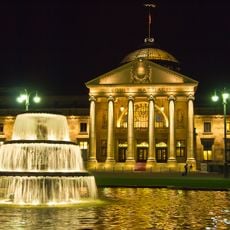
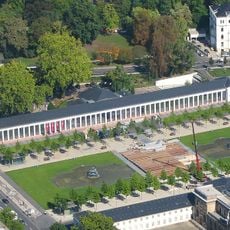
Bowling Green is a long rectangular lawn in Wiesbaden with two water basins, each holding a three-shell cascade fountain. Four parallel avenues were laid out after 1810: the outer rows of poplars and lindens for carriages and riders, the inner rows of acacias, replaced by plane trees in 1817, for pedestrians. The inner walks lie slightly lower, giving the sunken profile typical of a bowling green.
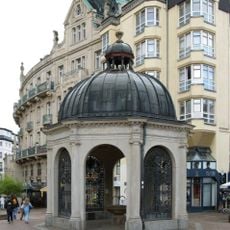
A fortified path about 250 m long ran through the site from the late 17th century, leading from the Sonnenberger Tor to the Sweet Well, a drinking-water spring documented since 1477. City architect Christian Zais built the Cursaal here in 1808–1810, and four parallel avenues were planted in 1810. The Cursaal was demolished in 1905 and replaced by Friedrich von Thiersch's Kurhaus, completed in 1907.
The name comes from the English game of bowls, once played here when wealthy British visitors came to Wiesbaden as a spa resort. That connection to English leisure culture is still part of the park's identity today, even though the lawns are now used for strolling and open-air events.
A parking garage sits directly beneath the park, making it easy to arrive by car and walk straight up to the green. The Kurhaus, the casino, and the main shopping street are all within a short walk from here.
The two three-shell cascade fountains were installed in 1856, fed by a reservoir on the Schöne Aussicht height that had been built to supply the Paulinenschlösschen. The water came from the Frauenborn in the upper Tennelbach valley. The Bowling Green's sunken inner lawn, lower than the outer carriage ways, is what gives it the character of a real bowling green.
The community of curious travelers
AroundUs brings together thousands of curated places, local tips, and hidden gems, enriched daily by 93,858 contributors worldwide.