Spielbank Wiesbaden, Gaming establishment in Wiesbaden, Germany
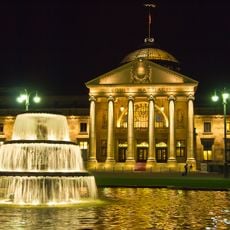
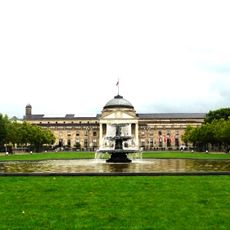
Spielbank Wiesbaden occupies the former wine salon within the historic Kurhaus building and offers roulette, blackjack, poker, and roughly 170 slot machines spread across different sections. The spaces combine historic architecture with modern gaming facilities across multiple levels.
Gambling was licensed in Wiesbaden by a 1771 privilege from Prince Carl of Nassau-Usingen, and roulette was introduced eleven years later. In 1810 the casino moved into the newly built Alte Kurhaus. After the Reich law of 1872 closed the casinos, large-scale play resumed only on 29 October 1949, first in the foyer of the Hessian State Theatre. On 3 November 1955 the casino reopened in the north wing of the Kurhaus, and since its restoration the Great Game has occupied the former wine salon, a neoclassical hall with cherry-wood panelling and crystal chandeliers.
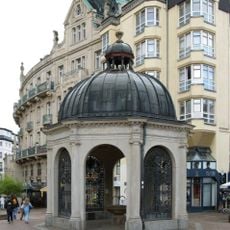
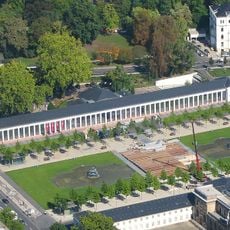
The casino's Great Game occupies the former wine hall of the Kurhaus, a neoclassical room with cherry-wood wall and ceiling panelling and large crystal chandeliers. The Small Game sits in the Kurhaus colonnades, at 129 m the longest colonnade in Europe. The Wiesbaden Super-Roulette is a local variant of the game.
The Great Game occupies the former wine salon in the north wing of the Kurhaus, while the slot machines sit in the adjoining Kurhaus colonnades, a 129-metre columned hall. The casino is wheelchair accessible. Around 200,000 visitors pass through each year.
The casino's roulette has a local variant, the Wiesbadener Super-Roulette, and an early one-of-a-kind version called Roulite. The Great Game sits in the Kurhaus's former wine salon, panelled in cherry wood and lit by large crystal chandeliers; the slot hall opened in the Brunnenkolonnade as the "Goldene 13."
The community of curious travelers
AroundUs brings together thousands of curated places, local tips, and hidden gems, enriched daily by 94,026 contributors worldwide.