Ernst-Ehrlicher-Park, English garden and monastic garden in Hildesheim, Germany.
Ernst-Ehrlicher-Park is a 4.8-hectare English landscape garden in Hildesheim, bordered by the Dyesgraben to the north and the Mühlengraben to the west and south. Its layout of broad lawns, old trees, small bridges and linked ponds survives from the redesign of the Villa Dyes garden around 1885. The ponds began as fish ponds of the Godehardikloster, and the northern one was enlarged into the town moat in 1461.
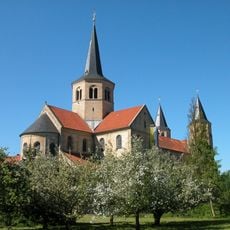
The site began as the garden of the Godehardikloster, first documented on 11 March 1146, where monks dug three fish ponds and grew vines on the slope toward today's Weinberg street. In 1461 the northern pond was enlarged into the town moat. After secularisation the city took over the land, and around 1885 the Dyes family's villa garden was redesigned as an English landscape garden, opened to the public as Dyes-Park on 29 June 1929 and renamed Ernst-Ehrlicher-Park in 1938.
The park is named after Ernst Ehrlicher (1872–1951), Hildesheim's long-serving mayor, who retired in 1938. In 2006 the Frauen-Labyrinth project laid out a rose labyrinth 23 m across with a 600 m path, described as a meeting place for all.
The park has multiple walking paths and many benches spread throughout for resting and taking in the surroundings. It is easy to access and open to visitors year-round.
The rare Kahlrückige Waldameise (naked-backed wood ant) nests near the Dyesgraben in warm, sunny spots, and the scaly root Lathraea squamaria blooms pink there in March and April. Kingfishers and tawny owls are sometimes seen at the ponds, and several bat species live in the park and adjoining ramparts. In 2016, 30 habitat trees were designated to protect them.
The community of curious travelers
AroundUs brings together thousands of curated places, local tips, and hidden gems, enriched daily by 92,883 contributors worldwide.