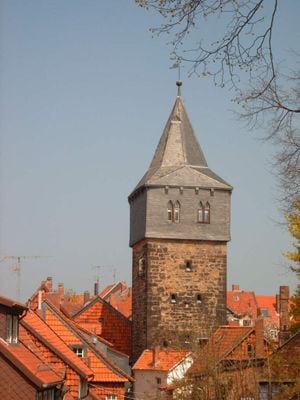
Kehrwiederturm, Medieval defense tower in Hildesheim, Germany.
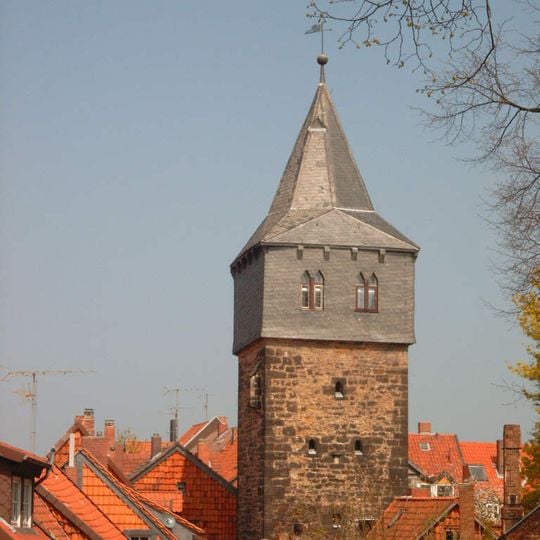
The Kehrwiederturm is a 30-metre defense tower on Keßlerstraße, the last of four towers from Hildesheim's city fortifications. Its square shaft is built of rough reddish-brown rubble stone up to the upper section, which is clad in grey slate and pierced by two pairs of arched windows. A steep slate pyramid roof with a small dormer, spire and weather vane tops the structure.
The Kehrwiederturm is the last surviving of the four original towers of Hildesheim's city fortifications. Sources disagree on its construction date: some name 1456, others around 1300. It was first called Honser Tor after the nearby village of Hohnsen, and the name Kehrwiederturm came into use around 1600.
The tower's name may come from the near right-angled bend of the rampart below it, or from the bell that, by legend, guided a lost noblewoman home. That bell was later moved to the nearby Lambertikirche. Since 1982 the Kunstverein Hildesheim has used the tower for exhibitions, and the registry office holds weddings there.
The tower stands on Keßlerstraße, where the wall makes an almost right-angled turn below it. It is used by the Kunstverein Hildesheim as its seat and for exhibitions, and the city registry office holds weddings inside. Since it is not a public viewing platform, confirm access and opening times with the Kunstverein before visiting.
The tower was first called Honser Tor, after the nearby village of Hohnsen; the name Kehrwiederturm only caught on around 1600. Its bell, rung to call citizens back inside the walls, was later moved to the nearby St. Lamberti church. Others trace the name to the near right-angled bend of the rampart below the tower.
The community of curious travelers
AroundUs brings together thousands of curated places, local tips, and hidden gems, enriched daily by 93,943 contributors worldwide.