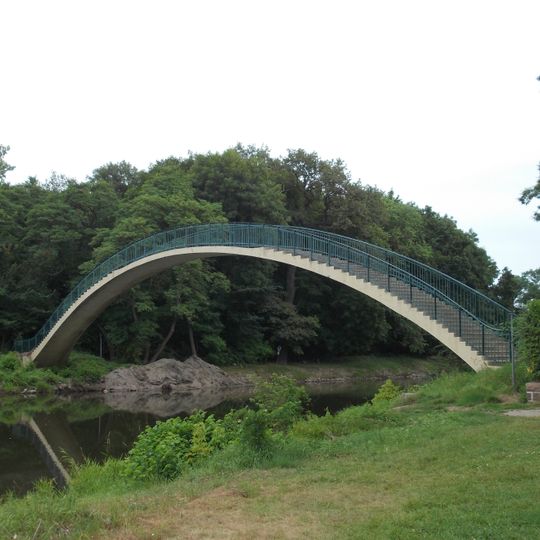
Forstwerderbrücke, Bridge in Halle (Saale)
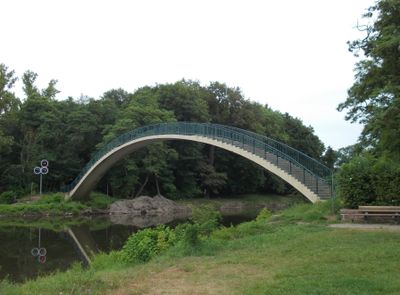
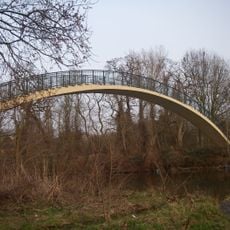
The Forstwerderbrücke is a pedestrian arch bridge in Halle (Saale) built in 1928 that connects the Forstwerder island area with the opposite bank. The structure is made of steel-reinforced concrete with a span of about 47 meters and a maximum height of about 6.7 meters, allowing boats to pass underneath.
The bridge was built in 1928 based on a design by Adolf Heilmann, replacing an older ferry that transported people across the river. It represents engineering from the late 1920s and has served the community for nearly a century.
The bridge owes its nickname "Katzenbuckelbrücke" (cat hump bridge) to the shape of its reinforced concrete arch. It replaced the ferry that once carried bathers to the river swimming pool on Forstwerder island; the pool is gone, and the island now lies within a protected landscape area.
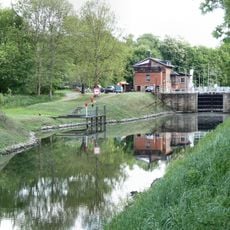
The bridge crosses the Mühlgraben, a side arm of the Saale that also serves as the approach to the Trotha lock, right next to the Trotha weir. Its arch rises 6.7 metres at the apex so that shipping traffic on the water below is not obstructed. Steps were poured onto the concrete deck, so expect a stepped crossing rather than a level walkway.
Locals sometimes call the bridge the 'Katzenbuckelbrücke' because of its curved arch shape that resembles a cat's arched back. This local nickname reflects the familiarity residents have with this everyday crossing and its distinctive appearance.
The community of curious travelers
AroundUs brings together thousands of curated places, local tips, and hidden gems, enriched daily by 93,469 contributors worldwide.