Emmauskirche, Medieval church in Borna, Germany
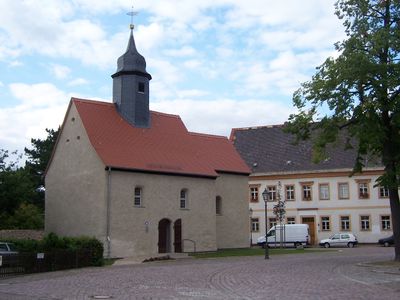
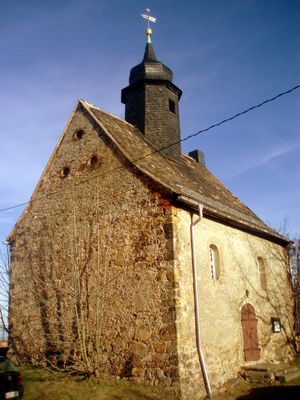
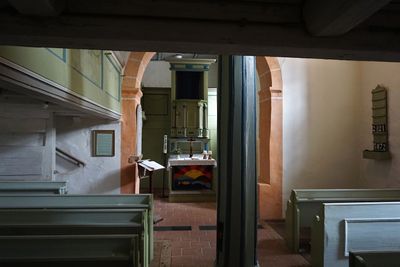
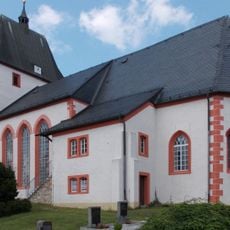
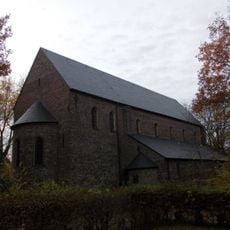
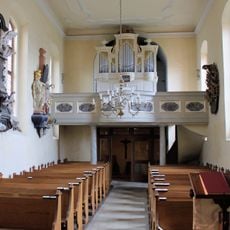
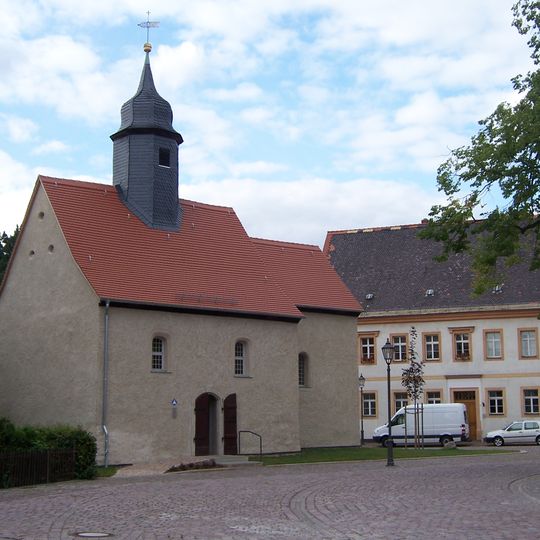
Emmauskirche is a Romanesque fieldstone church with a recessed rectangular choir, moved in one piece from Heuersdorf to Borna in 2007. Its pale, rough-textured walls and steep red-tiled roof carry a slate-grey tower with a pointed spire and cross. Inside, a Renaissance coffered ceiling rests on a single flower-painted support.
The church's origins go back to the 13th century, and it was first mentioned in a document in 1297, making it the oldest surviving building in Heuersdorf. It was named Emmauskirche only in 1959, when Heuersdorf was merged with Großhermsdorf. In 2007 the entire structure was moved to Borna to make way for the Schleenhain open-cast coal mine, and it was rededicated on Easter Monday 2008.
The name dates only from 1959, when Heuersdorf was merged with Großhermsdorf and the church needed to be distinguished from the Tabor church there; it refers to the village of Emmaus where the risen Jesus appeared to two disciples. Inside, the pulpit altar, organ and gallery in Neo-Renaissance forms date from the 19th century, while the Renaissance wooden coffered ceiling rests on a single painted column.
The church now stands beside Borna's Stadtkirche, its former site in Heuersdorf having been excavated for lignite. It is no longer a parish church but is used for peace prayers and exhibitions, so opening times depend on those events. The transport route crossed the Pleiße at Lobstädt and the Wyhra before Borna.
The 665-tonne church was moved on self-propelled modular transporters with 40 axle lines, and slopes on the route could not exceed 2°. Before transport, 30 m³ of foam mortar was injected into 1,800 boreholes because the three-shell fieldstone masonry had a void ratio of 30 to 40 percent.
The community of curious travelers
AroundUs brings together thousands of curated places, local tips, and hidden gems, enriched daily by 93,881 contributors worldwide.