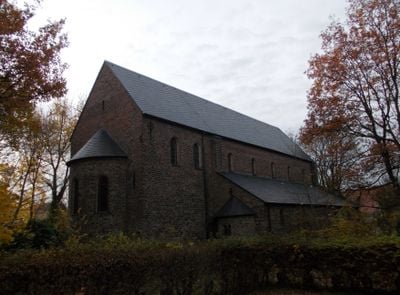
Kunigundenkirche, Romanesque brick church in Borna, Germany.
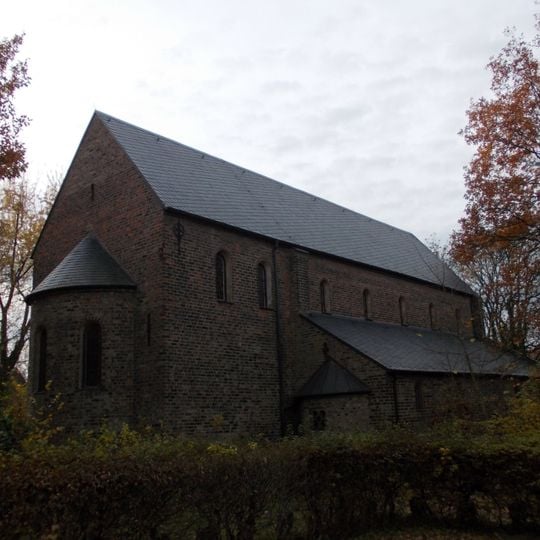
Kunigundenkirche is a long, towerless brick pillar basilica built before 1200, with a tall central nave under a steep dark roof and lower side aisles with shed roofs. A small round tower with a conical roof stands at the left corner. Shallow brick pilasters divide the side wall into bays with narrow round-arched windows, and a lower aisle with a small porch extends to the right.
Built of brick before 1200, the church was possibly founded under the influence of Emperor Frederick Barbarossa and dedicated to Kunigunde of Luxembourg, wife of Emperor Henry II. After the Reformation it served as a burial church and was remodelled in Baroque style in 1620. The restoration by Emil Högg from 1923 to 1932 removed a Baroque wooden barrel vault and rebuilt the side-aisle walls and north apse, reconstructing the Romanesque state.
The church is dedicated to Kunigunde of Luxembourg, wife of Emperor Henry II. In the nave, 15th-century wall paintings survive: on the north side Margaret, Dorothy, Barbara and the martyrdom of Saint Sebastian, on the south side the Crucifixion, an apocalyptic Madonna and Christopher. The main apse holds a Majestas Domini from the building period, largely lost, with additions from around 1930.
The church stands in Borna, in the district of Leipzig, and is reached on foot from the town centre. The surrounding cemetery was closed in 1895, so the building now sits without its former burial ground. Services and events of the St. Marien congregation can restrict entry.
The 1502 late-Gothic carved altar inside came from the demolished church of Görnitz; its shrine shows Saints Joachim, Mary and Anne with the Christ Child, and the wings hold eight saints from the circle of the Naumann brothers' workshop in Altenburg. The damaged outer wings carry a painted Annunciation.
The community of curious travelers
AroundUs brings together thousands of curated places, local tips, and hidden gems, enriched daily by 93,005 contributors worldwide.