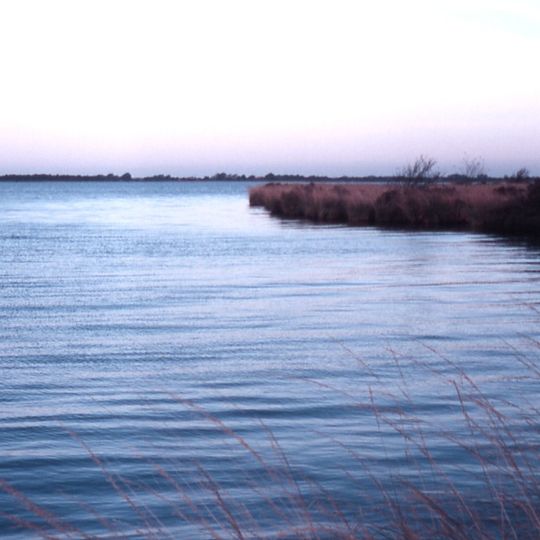
Ewiges Meer, Lake in Eversmeer, Germany
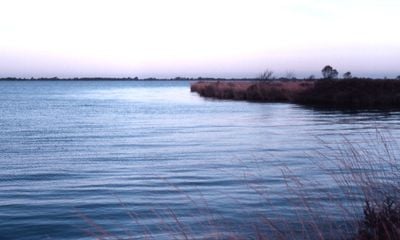
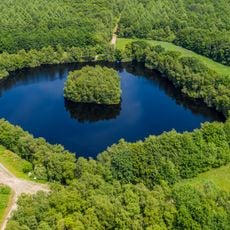
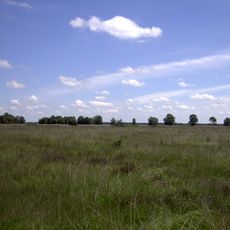
Ewiges Meer is a water body in the East Frisian region covering about 91 hectares with a maximum depth of around 3 meters. The lake extends across approximately 1.65 kilometers and forms a calm basin surrounded by natural vegetation in the flat landscape.
The open water arose when three raised bogs — Berumerfehner, Tannenhausener and Meerhusener Moor — grew together and blocked the drainage of rainwater. Because the bogs joined only recently, the peat layer around the lake is in places just one metre thick. The area was first protected in 1939; in 1990 it was absorbed into the Großes Moor nature reserve and enlarged in 2019.
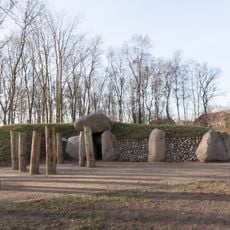
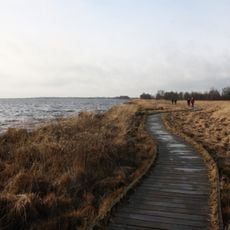
The name Ewiges Meer, "Eternal Sea", refers to the open water that never silted up. The surrounding moor yielded the Bernuthsfeld bog body and the roughly 2,000-year-old plank track in the Meerhusener Moor, after which the 1.8 km boardwalk on the north shore is modelled. The megalithic tomb of Tannenhausen, locally called Butter, Brot und Käse, lies nearby.
A 1.8 km boardwalk runs along the northern edge, built in the early 1980s and supplemented in 2000 with a moorland nature trail. After a 2018 accident it was closed, then partly reopened as far as the first viewing platform; the remaining stretch was still closed and in poor condition as of August 2023. The southern part of the reserve is not accessible to visitors.
The lake's surface lies at about 8.5 metres above sea level, and the peat layer around it is in places only one metre thick, because the three bog bodies that merged here joined only relatively recently. Beside the main water there are smaller bog pools such as the Kleines Eversmeer, the Dobbe and two Krickmeere, where the last black terns in East Frisia still breed.
The community of curious travelers
AroundUs brings together thousands of curated places, local tips, and hidden gems, enriched daily by 95,259 contributors worldwide.