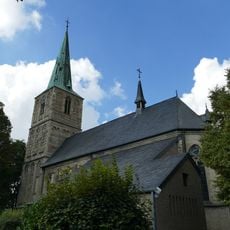
St. Mariä Himmelfahrt, Medieval pilgrimage church in Ginderich, Germany
St. Mariä Himmelfahrt is a church in Ginderich near Wesel with a well-preserved Romanesque west tower from its earlier period. The interior space was expanded in the 14th century, when the choir and nave were reconstructed.
The church was first mentioned in 1190, when Archbishop Anno II of Cologne recorded a church dedicated to the Virgin Mary that showed miraculous signs to those who prayed there. Its Romanesque west tower survives from that building; the choir and nave were demolished in the 14th century and replaced by a larger structure to hold the growing number of pilgrims. In 1640 the pilgrimage was legally ended under Elector Friedrich Wilhelm, and the Diocese of Münster officially restored Ginderich as a pilgrimage site in December 2005.
The pilgrimage, banned by Elector Friedrich Wilhelm in 1640, was officially reinstated by the Diocese of Münster in December 2005. Since spring 2016 a local association, founded to promote art and culture at St. Mariä Himmelfahrt, organises organ concerts on the restored 19th-century Conacher organ with two manuals and 20 stops.
The church stands in Ginderich, a district of Wesel on the Lower Rhine, and can be reached by road from Wesel and the surrounding villages. The west tower survives from the Romanesque building, while the south side gained a sacristy and porch in 1870. Visitors enter through that south porch; the interior is a three-aisled space.
The baptismal font, made around 1470–1480, survives almost complete. The four late Gothic carvings show James, Rochus of Montpellier, probably Winfried Bonifatius and the church's founding bishop. In March 2016 a restored 19th-century English Conacher organ with two manuals and 20 stops was installed, and a society founded that spring promotes concerts on it.
The community of curious travelers
AroundUs brings together thousands of curated places, local tips, and hidden gems, enriched daily by 94,548 contributors worldwide.