Holy Trinity church, church in Zerbst, Germany
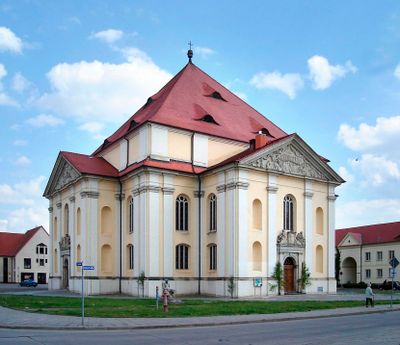
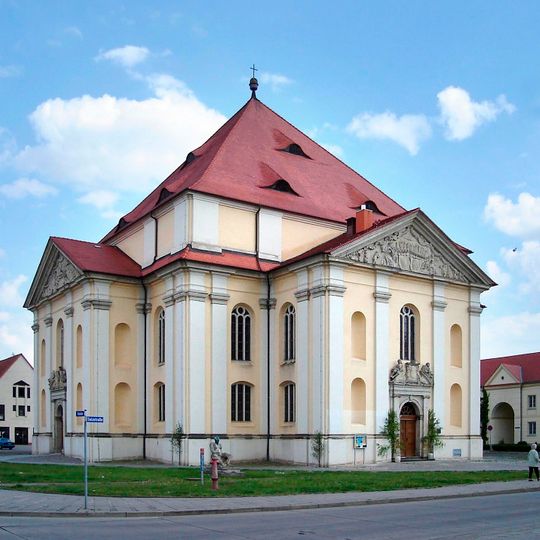
The Holy Trinity church is a central-plan baroque building in Zerbst, built on the outline of a Greek cross with four equal arms. Its crossing cube carries a high tent roof and a tower finial of unusual shape. The four facades, modeled on Amsterdam's Oosterkerk, resemble a theatre or concert hall more than a church. Inside are Simonetti's high altar with a full relief Resurrection group, a Romanesque font about 800 years old, and a 1962 organ with 2,200 pipes.
The Holy Trinity church was designed and built between 1682 and 1696 by Dutch architect Cornelis Ryckwært, inspired by Amsterdam's Oosterkerk. In 1945 the building suffered severe damage from fire and bombardment during the war, destroying many artworks; restoration began in the 1950s and was completed with major repairs in 1991.
The church is dedicated to the Holy Trinity, the Christian doctrine of three persons in one God. Since 2003 it has served as a modern community centre, and its 1962 Schuster organ, the largest between Magdeburg and Wittenberg, is used for concerts. The name Trinitatis appears on the 1696 consecration.
The church is open to visitors and offers guided tours explaining its construction, history, and artworks. It sits centrally in Zerbst and allows easy access for exploring both the building and the surrounding old town.
The church was modeled after Amsterdam's Oosterkerk by Dutch architect Ryckwært, showing how Dutch design ideas reached German cities. This architectural connection makes it a rare example of how building styles crossed borders in the baroque era.
The community of curious travelers
AroundUs brings together thousands of curated places, local tips, and hidden gems, enriched daily by 92,885 contributors worldwide.