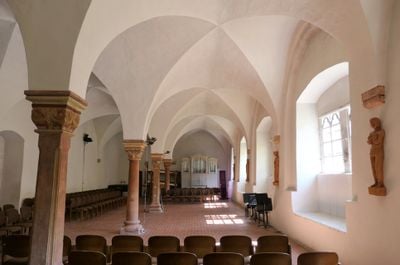
Michaelstein Abbey, Cistercian monastery in Blankenburg, Germany
Michaelstein Abbey is a former Cistercian monastery near Blankenburg in the Harz. Its west wing holds a Baroque church with a vaulted interior of white plastered pointed arches, squat columns with tan marbled shafts and carved capitals, and a floor of small reddish-brown tiles. A light-colored organ with vertical pipes stands at the far end beneath a dark wooden balcony, and narrow windows on the right wall light the space.
Beatrix II, abbess of Quedlinburg, is named as founder in the 1146 charter; Pope Innocent II confirmed the endowment in December 1139, and monks from Kamp settled the house in 1146 under Abbot Roger. The church was destroyed in the Peasants' War on 10 May 1525 and never rebuilt, services moving to the chapter house. Wilhelm von Haugwitz plundered the abbey in 1533, and in 1543 the last Catholic abbot resigned, passing it to the Counts of Blankenburg.
The former abbey now houses the Stiftung Kloster Michaelstein, a music institute for performance practice, and since 2001 the Landesmusikakademie of Saxony-Anhalt. Its Michaelsteiner Klosterkonzerte feature the Kammerchor Michaelstein and the Telemannisches Collegium Musicum, and the annual Klosterfest is a highlight. A museum holds mainly historical musical instruments, and guided tours include herb and vegetable gardens laid out from historical sources.
The monastery is open daily and welcomes visitors to walk through the cloister buildings, explore the gardens, and view the music exhibition museum. Parking is available near the entrance, making access straightforward for those arriving by car.
The monastery gardens grow more than 260 varieties of medieval herbs and vegetables using traditional cultivation methods. This living garden demonstrates what monks actually grew and used in daily life.
The community of curious travelers
AroundUs brings together thousands of curated places, local tips, and hidden gems, enriched daily by 94,999 contributors worldwide.