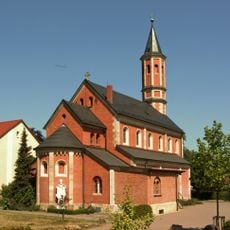
St. Bartholomäus, Romanesque church in Blankenburg, Germany
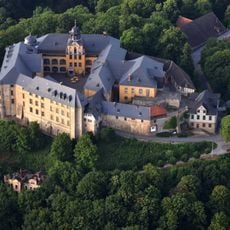
St. Bartholomaeus is a three-nave church standing on a hillside below the Great Castle in Blankenburg's old town. The building displays Romanesque architecture with later modifications and occupies a central position between the castle above and the marketplace below.
Construction of the three-nave Romanesque parish church began under Count Siegfried II, and in 1203 Theodericus plebanus de Blankenburg is recorded as its first pastor. In 1252 it was rebuilt as the monastery church of a double house of secular canons and Cistercian nuns, with a Gothic choir, two side chapels and a nuns' gallery. The canons' foundation was dissolved in 1305 and the convent in 1532 during the Reformation, after which St. Bartholomäus again served as a parish church.
Four donor figures in the choir represent the counts who funded construction. A Renaissance pulpit from 1582 displays carved representations of faith, love, hope, and justice.
The church stands on a slope above the old town, reachable on foot from the marketplace; the Harz Monastery Trail passes through it as a stage. The organ, housed in an 1891 case, was rebuilt in 1931 by Furtwängler & Hammer and fully restored in 2009/10 by Jost Truthman. The west entrance area holds a cross-shaped memorial to Duke Friedrich Wilhelm, the "Black Duke" fallen in 1815, and to Blankenburg's war dead.
The organ case dates from 1891, while the instrument itself was rebuilt in 1931 by Furtwängler & Hammer of Hanover following the principles of the Orgelbewegung, reusing pipes from the 1838/39 Romantic organ by Wilhelm Boden. Jost Truthman of Frankfurt (Oder) restored it in 2009/10. Of the four bells bought in 1858, three were melted down in the First World War and replaced by cast-steel bells in 1922.
The community of curious travelers
AroundUs brings together thousands of curated places, local tips, and hidden gems, enriched daily by 92,688 contributors worldwide.