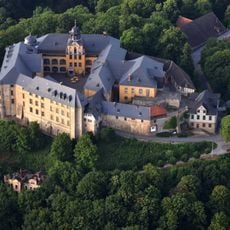
Schlossgarten blankenburg harz, Baroque gardens at Blankenburg Castle, Germany
Schlossgarten Blankenburg is a Baroque park with terraced levels rising toward the Great Castle and featuring stone sculptures, clipped hedges, and water features distributed across multiple tiers. The design connects different elevation zones through pathways and formal garden elements that guide movement through the space.
The garden evolved from a 17th-century ducal hunting ground and underwent complete restructuring between 1707 and 1731 under Ludwig Rudolf of Brunswick-Wolfenbüttel. This period established the Baroque structure that remains visible today.
The sandstone rims of the terraces carry putti added during the 1970s reconstruction; they came from a Blankenburg spa whose owner bought them around 1900, and they were probably made for Salzdahlum Palace. The original vases, by contrast, bear the initials CL for Christine Luise. The Neptune Grotto with its trident-bearing god and two sphinxes was added after Ludwig Rudolf's death by his widow.
The terraced garden lies by the castle and the medieval town wall; the Hirschtor, the ducal gate into the former Tiergarten, stands at the edge of town on the road toward Cattenstedt. The sandstone-edged terraces are linked by paths and steps, and the slope between the Neptune Grotto and the lower fountains is steep. Sturdy shoes help after rain.
The sandstone terrace edges carry putti added only in the 1970s, acquired around 1900 by a Blankenburg spa owner and probably made for Salzdahlum Palace. The original pieces are the vases bearing the initials CL for Christine Luise. Behind the Neptune Grotto stands a monument to Duke Leopold, drowned in 1785, moved here around 1935 after the Nazis banned the Freemasons.
The community of curious travelers
AroundUs brings together thousands of curated places, local tips, and hidden gems, enriched daily by 93,138 contributors worldwide.