St. Mauritz Church, Gothic collegiate church in Münster, Germany
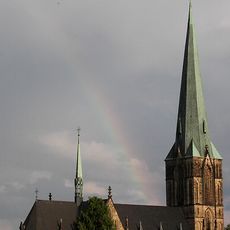
St. Mauritz Church in Münster has two Romanesque east towers flanking a Gothic choir that replaced the original square Romanesque choir with its apse in the 15th century. The neo-Romanesque nave, built 1859–1861 to a design by diocesan architect Emil von Manger, replaced a single-aisle Romanesque ship. The sacristy on the south side of the choir partly reuses old Romanesque masonry.
St. Mauritz was the collegiate church of a canonry founded probably by Bishop Friedrich I (d. 1084); the Romanesque east towers suggest construction around 1064. Friedrich and his successor Erpho were buried here, and Erpho's grave became a place of veneration. Bishop Burchard (1098–1118) added convent buildings and a cloister with chapels. In 1529 chaplain Bernhard Rothmann preached reformist sermons here, making the foundation a starting point for Münster's Anabaptist period; the canons were dissolved in 1811.
The church takes its name from Saint Maurice, leader of the Theban Legion martyred around 290 at Agaunum; his feast day is 22 September. The high altar painting of the Crucifixion, long attributed to Anthony van Dyck, was painted in the 17th century by Jan Boeckhorst, a pupil of Rubens, and shows provost Arnold von Vittinghoff as donor. A Crucifixion panel of 1547 hangs on the south choir wall.
The church is open to visitors and regularly used for services and tours. It is wise to check opening times before visiting and respect any religious services taking place during your visit.
The twelve reliefs on the eastern choir towers are among Germany's earliest stone sculpture, carved around 1090. They show five female saints and five soldiers; four were moved to the Westfälisches Landesmuseum in 1890 and replaced by copies, and only three of those four survive.
The community of curious travelers
AroundUs brings together thousands of curated places, local tips, and hidden gems, enriched daily by 92,832 contributors worldwide.