Klusfelsen, Natural rock formation in Goslar, Germany
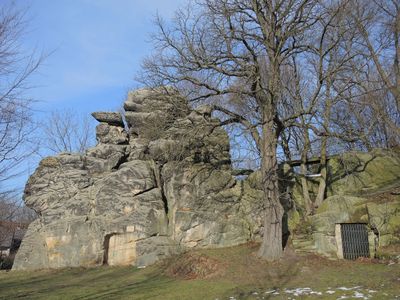
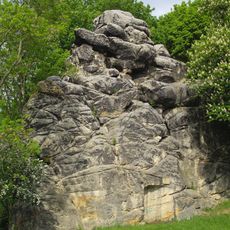
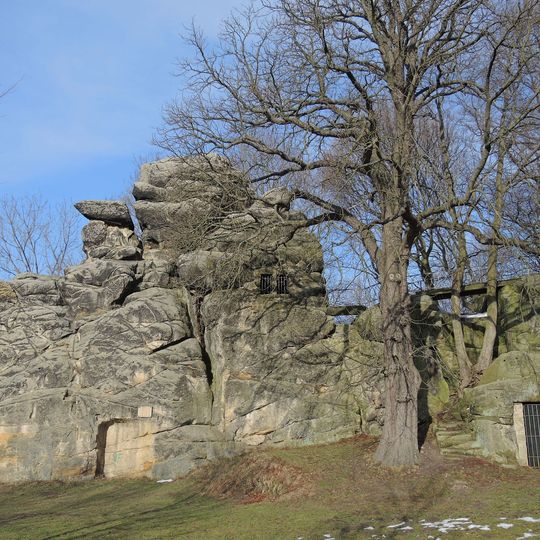
Klusfelsen is a sandstone ridge in Goslar, below the Petersberg at the edge of the Harz. It rises almost 20 metres high and 50 metres long from nearly flat ground about 250 metres above sea level. The yellow, porous, coarse-grained Hilssandstein formed about 110 million years ago in a shallow sea; because the strata were tilted almost vertically by block uplift in the early Tertiary, the rock face shows vertical bedding planes.
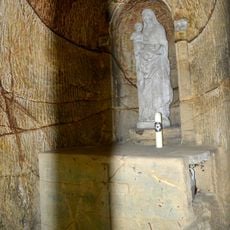
A chapel was built in a natural cave within the rock during the Middle Ages and served as a place of worship for centuries. Religious use of the site came to an end when the Reformation changed the region's religious practices.
The cave inside the rock has housed a Marian chapel since 1167, known as the Kluskapelle. After the Reformation it was used as a dwelling, and a chapel was reinstated in the early 19th century during the Romantic movement. It was renovated in 1983 with support from the Rotary Club of Goslar.
The rock formation is protected, and climbing or collecting samples is not permitted at this location. Visitors should view the formation from designated areas and follow any posted guidelines.
The vertical sandstone layers were created by tectonic shifts deep in the Earth's history. This unusual upright arrangement makes the site geologically noteworthy and different from many other rock formations in the area.
The community of curious travelers
AroundUs brings together thousands of curated places, local tips, and hidden gems, enriched daily by 94,365 contributors worldwide.