Kirche St. Elisabeth, Modern parish church in Kassel, Germany
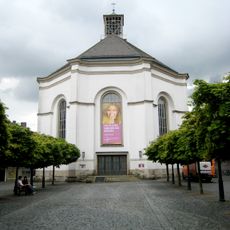
St. Elisabeth is a rectangular hall church built in 1959–60 to plans by Munich architect Armin Dietrich, with a steel skeleton, red brick infill in the upper two-thirds of the walls and clear-glass window bands at ground level. Its smooth exposed-concrete entrance facade has five horizontal joints and three hexagonal niches on the central axis. A separate square campanile of reinforced concrete and red brick stands nearby, its bell storey filled with perforated concrete blocks.
The current church was built in 1959–60 to plans by Munich architect Armin Dietrich, replacing the Elisabethkirche built by Simon Louis du Ry in 1770–1777, which was destroyed in World War II and demolished; the site of the old church was used for the Staatstheater. Bishop Adolf Bolte of Fulda consecrated the new building on 19–20 November 1960. On 1 January 2016 the parish was merged into St. Elisabeth parish with St. Bonifatius as parish church, making St. Elisabeth a filial church.
Five paintings by court painter Johann Heinrich Tischbein the Elder, saved from the earlier Elisabethkirche, hang here; they come from his Passion and Ascension cycle painted for that church in 1778, while the remaining panels are kept in the Fulda Cathedral Museum. The altar cross, a Madonna with Child and the 13 relief panels of the Stations of the Cross are works by the Kassel-born artist Alfred Schöpffe. In the Elisabeth chapel, a stone relief by Uwe Wenk Wolff shows Saint Elisabeth of Thuringia, the church's patron, handing out bread to the poor.
The church has been unusable since its roof collapsed across its full length at midday on 6 November 2023; a temporary emergency roof now covers it. The listed organ and possibly other artworks were damaged. The parish published a report on the causes in July 2024 and, after a survey of about 1,500 participants, announced in March 2025 that the site should serve religious, cultural and social uses.
The tower stands apart from the church like an Italian campanile. Its lower storeys are filled with red brick, the bell storey with perforated concrete blocks, and above it sits a wall-less storey closed by a very flat tent roof crowned with a sphere and cross. The four bells were cast in 1959 by Friedrich Wilhelm Schilling of Heidelberg, weighing 2440, 1327, 943 and 735 kg.
The community of curious travelers
AroundUs brings together thousands of curated places, local tips, and hidden gems, enriched daily by 94,228 contributors worldwide.