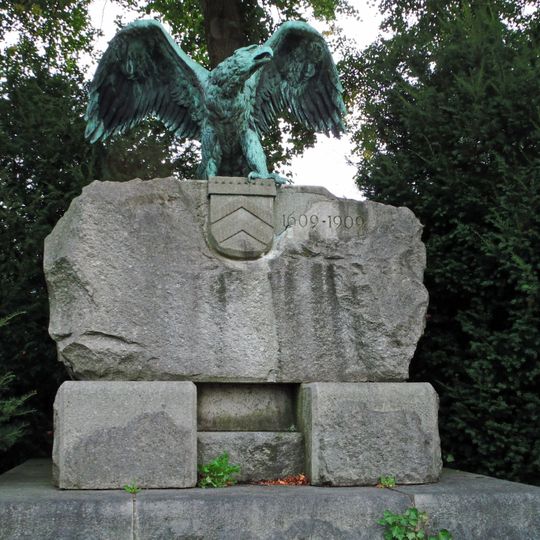
Grafschaftsdenkmal, Monument in Jöllenbeck, Bielefeld, Germany
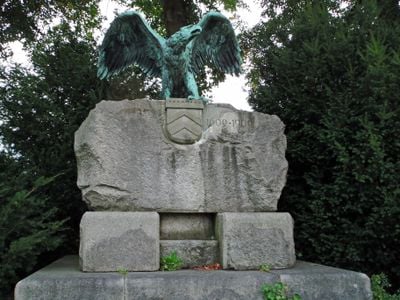
The Grafschaftsdenkmal is a monument in Bielefeld-Jöllenbeck consisting of a 12.25-tonne granite block set on a 1.5-metre-deep foundation, topped by a 375-kilogram bronze eagle. Sculptor Heinrich Wefing designed it; the eagle surmounts the plain stone base at the former Kantorgarten, where roads to Herford, Schildesche and Spenge met.
The monument was unveiled on 16 July 1909 to mark 300 years of Ravensberg under Brandenburg-Prussia. From 1897 the farmer and community leader Gustav Meyer zu Jöllenbeck campaigned to preserve the Tieplatz, and a citizens' meeting in June 1908 resolved to build the memorial; his cousin, the sculptor Heinrich Wefing, designed it. The ceremony drew an estimated 15,000 to 20,000 people, the largest gathering in Jöllenbeck's 800-year history.
The monument is also known locally as the Adlerdenkmal and stands at a busy junction in Jöllenbeck where it has become a familiar sight for residents. The site serves as a marker of the region's deep connection to Prussian history and continues to shape the community's sense of identity.
The monument stands at a junction in Jöllenbeck and is easily accessible on foot, especially from the nearby bus stop named after it. The location near Kantorgarten offers straightforward access for visitors interested in exploring local history.
The festivities were postponed from 16 to 24 July 1909 because of heavy rain, and the rescheduled folk festival at the Hof Upmeier zu Belzen was the first event in Jöllenbeck to be lit by electric light. It featured 43 groups in a historical pageant, gymnastics displays and choral and brass music.
The community of curious travelers
AroundUs brings together thousands of curated places, local tips, and hidden gems, enriched daily by 92,887 contributors worldwide.