Villa Seyd, Architectural heritage monument in Uellendahl-Katernberg, Wuppertal, Germany
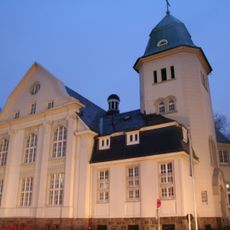
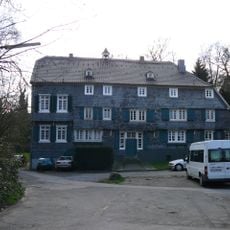
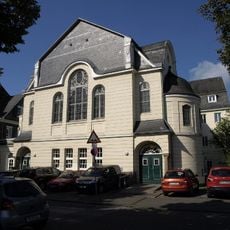
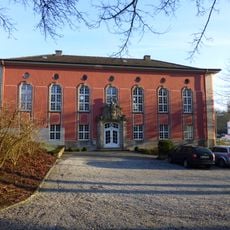
Villa Seyd is a neo-baroque villa built between 1897 and 1899 by architect Heinrich Plange for textile merchant Carl Hermann Seyd. The two-storey oval vestibule, topped by a skylight, served as a festival hall and gave access to the living room, music room, billiard room and dining room. Art historian Axel Kirchhoff notes its closeness to the Erbdrostenhof in Münster by Johann Conrad Schlaun.
Built for textile merchant Carl Hermann Seyd between 1897 and 1899, the villa was designed by architect Heinrich Plange from Elberfeld. It gained protected monument status in 1984.
The villa's name comes from the Seyd textile family, whose wholesale firm on Hofauerstraße was the first of its kind in what is now Wuppertal. Hermann Seyd was a supporting member of the Elberfelder Verschönerungsverein and funded improvements to the paths through the Mirker Hain, the woods north of the house. The two-storey oval vestibule, also used as a ballroom, gave access to the music, billiard and dining rooms.
Villa Seyd is a private apartment building at Adalbert-Stifter-Weg 54, formerly Kohlstraße 38, and is not open to visitors; the neo-baroque facade can be seen from the public street. The 1991 total renovation under architect Rudolf W. Hoppe followed the owner's 1984 demolition plans, which prompted the heritage listing.
The villa's park once covered 130,000 square metres; Friedrich Seyd sold off plots until only 2,000 square metres remained with the house, which he sold in 1961 to tax adviser Lommerzheim. Lommerzheim planned demolition in 1984, and that plan triggered the building's protection as monument D227.
The community of curious travelers
AroundUs brings together thousands of curated places, local tips, and hidden gems, enriched daily by 94,229 contributors worldwide.