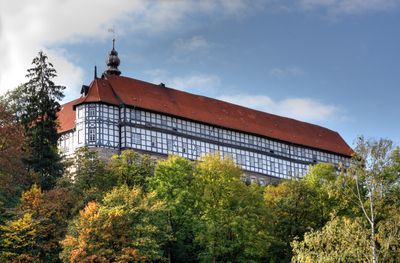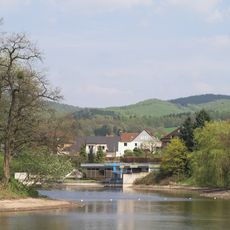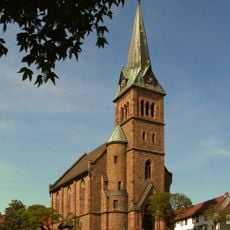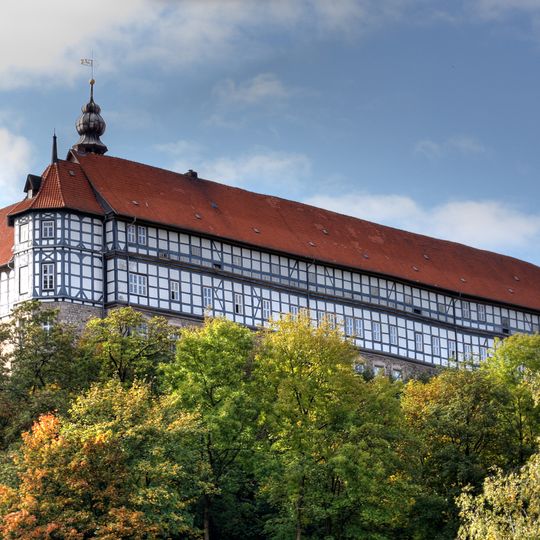
Herzberg Castle, Renaissance castle in Herzberg am Harz, Germany.
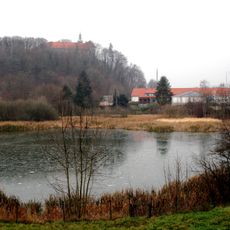
Herzberg Castle is a four-winged Renaissance schloss in Herzberg am Harz, enclosing a rectangular courtyard of 40 by 58 metres. Its lower storeys are rough grey stone, while the upper floors are half-timbered with dark beams and white plaster panels. A small tower with a tiered, bulbous cupola and spire rises at one end, and the steep roof is covered in red tiles.
A castle probably founded by Lothair III of Süpplingenburg in the 11th century, first indirectly recorded in 1050 and directly in 1156 and 1158. Henry the Lion acquired it in 1157 through an exchange with Frederick Barbarossa, and it stayed with the House of Welf for 708 years until 1866. After a fire in 1510 it was rebuilt as a four-winged Renaissance schloss, completed in 1528.
The castle is also called Welfenschloss Herzberg because it belonged to the House of Welf for 708 years, until the Kingdom of Hanover ended in 1866. Its museum displays a facsimile of the Gospels of Henry the Lion, a 12th-century Romanesque illuminated manuscript. Exhibits also cover Harz forestry, Herzberg arms manufacture and organ builder Johann Andreas Engelhardt.
The castle stands on a wooded hill west of Herzberg am Harz town centre, not in the centre. A road and a separate footpath lead up; there is a bus and car park in front of the gatehouse, and taxis and visitors with disabilities may drive into the courtyard. The museum is not wheelchair accessible.
The castle is Landmark 5 of the UNESCO Global Geopark Harz – Braunschweiger Land – Ostfalen. Its hill is undermined by water from the Sieber dissolving gypsum and dolomite, and a roughly 40 m thick rock slab creeps slowly toward the slopes. The museum inside is not barrier-free.
The community of curious travelers
AroundUs brings together thousands of curated places, local tips, and hidden gems, enriched daily by 93,159 contributors worldwide.