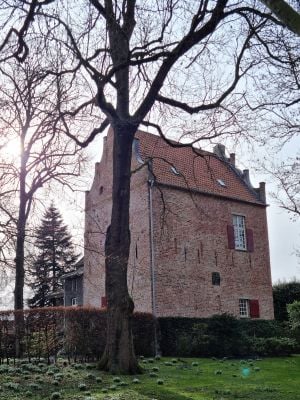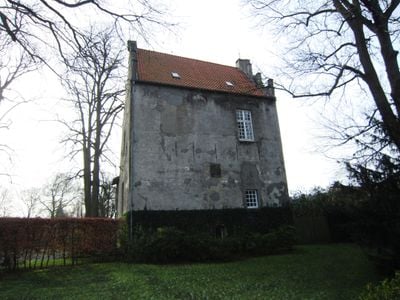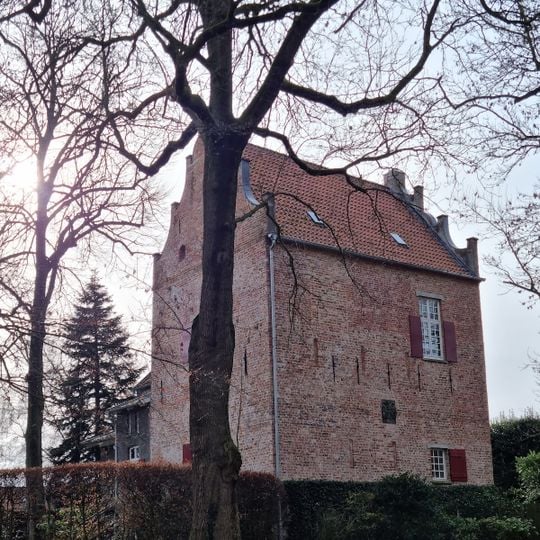
Harderwykenburg, Medieval stone house in Leer, Germany.
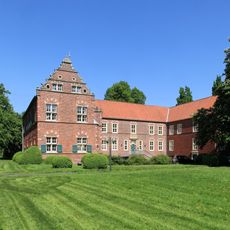
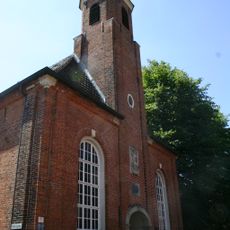
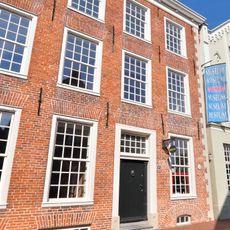
The Harderwykenburg is a medieval stone house in Leer constructed with stones salvaged from a former monastery, its exterior walls measuring between 0.96 and 1.23 meters thick. The structure combines an original tower section with a two-story extension that was added at a later period.
Hayo Unken, grandson of Focko Ukena, built the Unkenburg around 1470 on a Geest hill a few hundred metres from the destroyed Fockenburg of 1421. It is one of the youngest examples of an East Frisian chieftain's "high house". In the 17th century Dietrich Harderwyk, who married into the Unken family, converted the storage tower into a dwelling with a U-shaped annex and a Renaissance gable, giving it his name. In 1788 Carl Gustav Freiherr zu Innhausen und Knyphausen bought the house at auction from the von Schilling family; his descendants still own it.
This structure is a steenhuis, a fortified dwelling type that was common in East Frisia, featuring a tower with a later two-story extension added to one side. The thick walls and sturdy design reflect how wealthy families of that era protected themselves and their property from raids.
The building stands on a Geest hill at Harderwykensteg in Leer, a few hundred metres from the site of the destroyed Fockenburg. It is privately owned by the counts of Innhausen and Knyphausen, so visits are limited to viewing the tower and its U-shaped 17th-century extension from the street. Look for the stone coat of arms of the von Schilling family on the north side.
The tower's lower floor and first upper floor had no connecting stair; each had its own entrance, and the upper one was reached by a retractable wooden structure. This was meant to prevent attackers from smoking the defenders out. A moat was dug around the building in 1573.
The community of curious travelers
AroundUs brings together thousands of curated places, local tips, and hidden gems, enriched daily by 93,771 contributors worldwide.