Hexenturm, Medieval tower gate in Jülich, Germany
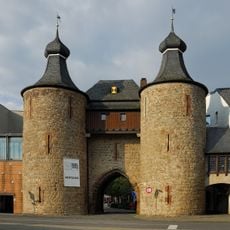
The Hexenturm is Jülich's only surviving medieval town gate, a twin-tower Gothic structure of rubble stone. The towers rise 12.75 metres to the top of the masonry, which is 1.60 to 2.30 metres thick. The passage is 4.70 metres wide and 5.20 metres high, with guides for a portcullis and 17 crossbow loopholes.
The gate tower was built in the early 14th century as part of Jülich's fortifications. It was later converted into a prison facility for the Duchy of Jülich and served an important function in enforcing local justice for centuries.
The name 'Hexenturm' became common in the 18th century, when the gate served as prison of the high and criminal court of the Duchy of Jülich; earlier names included 'Gefangenenthürn' and 'Hessenturm'. The witch name is misleading: only a few individual witch trials are recorded for Jülich. Since 2005 the Kunstverein Jülich uses the tower rooms for exhibitions by regional and neighbouring-country artists.
The tower stands on the eastern side of Walramplatz and is easily accessible from the city center. As an outdoor structure, visitors can view it at any time of day depending on their schedule and preferences.
The onion domes are not medieval: the towers first had crenellated fighting platforms, replaced by onion roofs only in the 17th century. The 1961–1964 restoration rebuilt those 17th-century domes faithfully; flat conical helmets were also debated, which would have let the town-side rectangular building with its pointed tent roof rise above the towers.
The community of curious travelers
AroundUs brings together thousands of curated places, local tips, and hidden gems, enriched daily by 93,849 contributors worldwide.