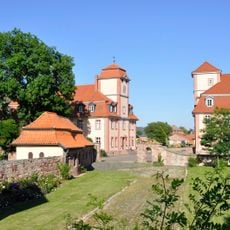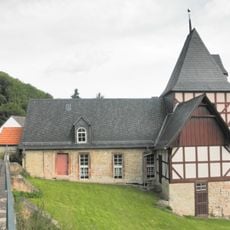
Abbaye de Göllingen, Benedictine monastery in Kyffhäuserland, Germany.
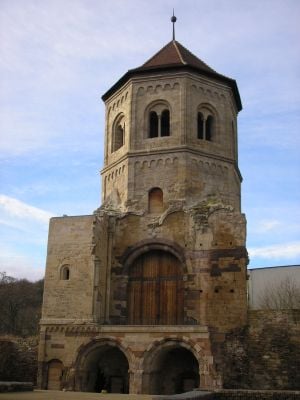
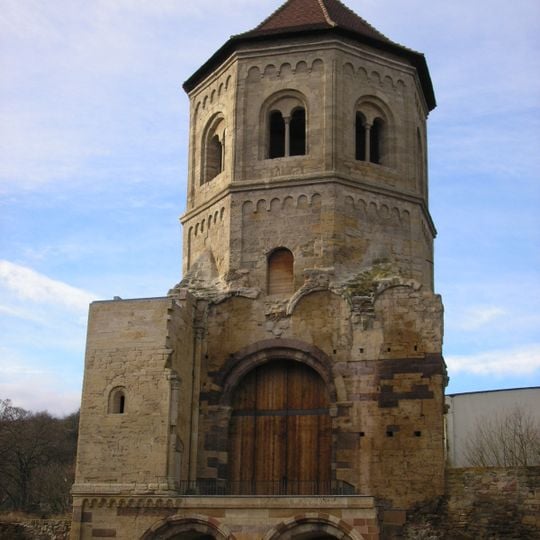
Kloster Göllingen is a ruined Benedictine monastery in Göllingen, Kyffhäuserland. Of the former complex, only the bell tower above the west choir survives, with the crypt beneath it, parts of the eastern apse and parts of the south wall. The tower is built of light tan and grey ashlar blocks with some reddish stones, its upper stage pierced by twin arched openings and topped by a band of small blind arches and a tiled hip roof. The ground plan of the church is marked out by gabion walls.
The site was founded around 1005 as a daughter house of Hersfeld Abbey and shaped the region's religious landscape for centuries. Following the Reformation and secularization in the early 1600s, the monastery was converted to secular uses.
The monastery is dedicated to Saint Wigbert, as was its mother house, Hersfeld Abbey. Since 1995 the tower and grounds have belonged to the Stiftung Thüringer Schlösser und Gärten, which opened the ruin to museum use; events are still held on the former monastery grounds. The church itself was used as a cannery from 1946 until 1995.
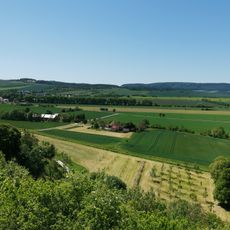
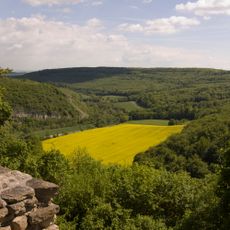
The monastery is best visited by car or bus from Sondershausen station, as it sits in a rural setting away from town centers. Wear sturdy shoes for exploring the grounds, as pathways are sometimes uneven and underground areas can be damp.
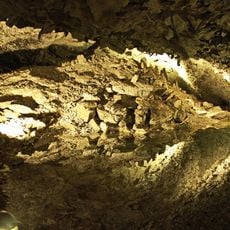
The Kleine Wipper, a canal branching off the Wipper at the "Wipperschere", runs about 530 m through the Mönchstunnel to reach Bad Frankenhausen, where its water drove pumps for brine extraction. The tunnel lies on that watercourse, not beneath the monastery, and the sources record no monastic engineering role in it.
The community of curious travelers
AroundUs brings together thousands of curated places, local tips, and hidden gems, enriched daily by 93,211 contributors worldwide.