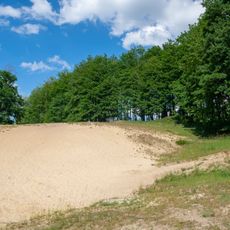
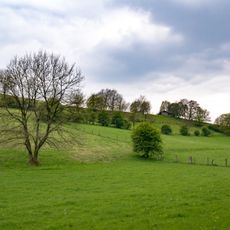
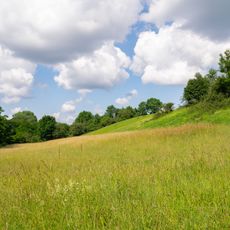
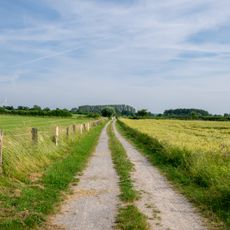
Hohlsteinhöhle, Protected cave system in Schlangen, Germany.
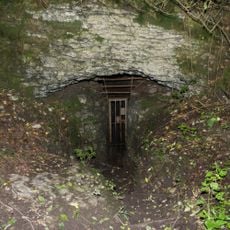
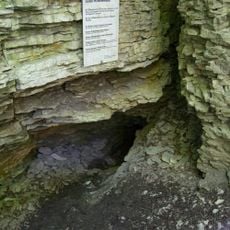
Hohlsteinhöhle is a natural fissure cave in the Plänerkalk limestone of the Eggegebirge, about two kilometres east-northeast of Kohlstädt. Its total length is roughly 200 metres and its greatest height 47 metres. The entrance, on a slope at about 420 metres above sea level, is closed by a four-metre-high grille; behind it the gravel-covered floor drops away, and after 30 metres a narrow passage opens into two chambers with stalactite formations in the rear parts.
The cave lies in the marl limestone of the Upper Cretaceous (Turonian, Lamarcki beds) of the Eggegebirge. It was already explored in 1779, making it one of the most important caves in East Westphalia. Today it is a natural monument and a bat hibernation site, so the public is barred except for a few exceptions.
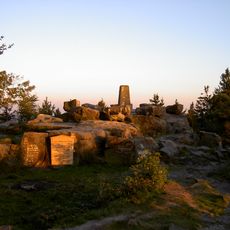
The cave lies in the Eggegebirge, about 600 m south of where that ridge meets the Teutoburger Wald, roughly 2 km east-northeast of Kohlstädt in the municipality of Schlangen. Its name is tied to the nearby Hohlestein summit (433.2 m), some 250 m east of the entrance. Because it is a designated natural monument and bat roost, entry is barred except in rare cases.
The cave lies about 2 km east-northeast of Kohlstädt, with its entrance around 250 m west of the Hohlestein summit at roughly 420 m above sea level. The entrance is barred by a gate 4 m high and 0.5 to 1.5 m wide, and public access is generally not permitted because the cave is a protected natural monument and bat hibernation site.
The cave beetle Choleva septentrionis sokolowskii, a subspecies found nowhere else in the world, lives only in the Hohlsteinhöhle. Both its larvae and adults feed on dead bats, bat droppings and food remains. The largest winter count of greater mouse-eared bats here reached 35 animals.
The community of curious travelers
AroundUs brings together thousands of curated places, local tips, and hidden gems, enriched daily by 93,850 contributors worldwide.