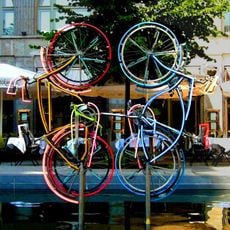
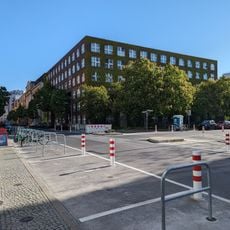
Tilla-Durieux-Park, Urban park at Potsdamer Platz, Berlin, Germany.
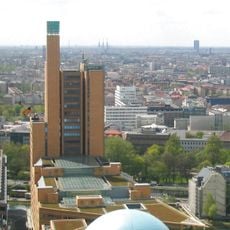
Tilla-Durieux-Park is an urban park at Potsdamer Platz in Berlin that winds through the densely built surroundings like a green corridor. It connects the area at Marlene-Dietrich-Platz with Landwehrkanal and features two striking grass-covered mounds as its central design elements.
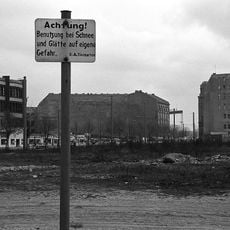
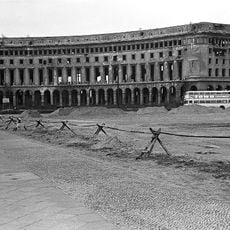
The park was built on the site of formerly destroyed train stations after World War II, symbolizing the reclaiming of a neglected central city area. Its realization in the early 2000s was part of a larger urban renewal effort at Potsdamer Platz.
The park is named after Tilla Durieux, an Austrian actress who worked in theatre and film. Its 485-metre lawn strip lies on the former Potsdamer Bahnhof railway land, and the adjacent Gabriele-Tergit-Promenade honours the journalist Gabriele Tergit. On sunny days Berliners and tourists use the grass for resting and sunbathing.
The park is a 50-metre-wide, 485-metre-long band running south from Potsdamer Platz to the Landwehrkanal, with a 30-metre lawn strip inside; the Gabriele-Tergit-Promenade borders it on one side. It lies entirely over the Nord-Süd-Fernbahn tunnel, whose ventilation shaft rises at the north end. The five aluminium seesaws in the central cut have been fixed to the ground since 2010 and can no longer be used.
The five aluminium seesaws in the park's central cut, each about 22 metres long, were designed by Dutch architect Bruno Doedens and installed in 2003. Intended for two users per side, they were repeatedly damaged through misuse or vandalism and were permanently fixed to the ground in 2010. The park's 485-metre length lies entirely over the tunnel of the Nord-Süd-Fernbahn, whose ventilation shaft protrudes into the park at its northern end.
The community of curious travelers
AroundUs brings together thousands of curated places, local tips, and hidden gems, enriched daily by 93,896 contributors worldwide.