Jostbergkloster, Gothic monastery ruins in Teutoburg Forest, Germany
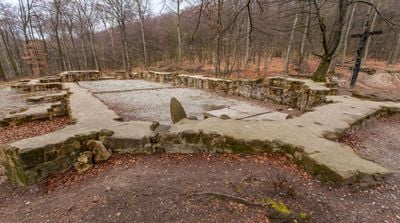
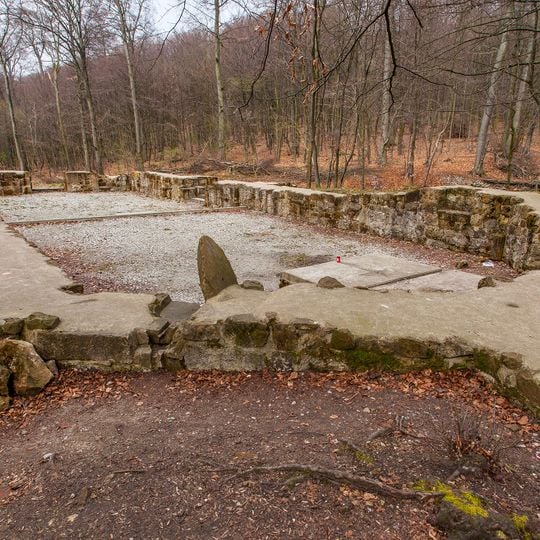
Jostbergkloster is a Franciscan monastery site in the Teutoburg Forest southwest of Bielefeld, with the church foundations rising about 3 feet (1 meter) above ground. The visible ruins show a single-nave structure with three bays and a choir roughly 30 feet (9 meters) wide.
In 1483 Bishop Simon III of Paderborn confirmed that pilgrims had venerated Saint Jodocus in a small house on the Loyckhuserberg since 1481, and he permitted a chapel. Franciscans arrived after 1496; Pope Alexander VI allowed a friary, and a new monastery built at the highest point of the Bielefeld–Halle pass road was consecrated in 1502. Complaints about wind, summer drought and isolation led Pope Julius II to approve relocation into Bielefeld on 10 June 1507.
The site's name comes from Saint Jodocus, the pilgrim patron venerated here from 1481 in a small hut on the Loyckhuserberg. Bishop Simon III of Paderborn authorised a chapel to Jodocus and the Virgin Mary in 1483, and the Franciscans were later called to serve the cult. The church was consecrated in 1502, but the friars moved to Bielefeld in 1507.
The site sits in the wooded surroundings of the Teutoburg Forest and functions as an archaeological location with visible ruins. You can view the foundations and remains while walking through the natural landscape.
Excavations uncovered fired tiles that reveal details of the original floor design. The remains also show the beginning of a spiral staircase that once stood beside the church entrance.
The community of curious travelers
AroundUs brings together thousands of curated places, local tips, and hidden gems, enriched daily by 94,608 contributors worldwide.