Wulsdorfer Friedhof, Cultural heritage cemetery in Bremerhaven, Germany.
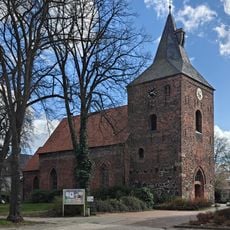
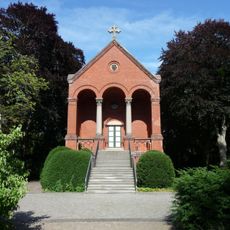
Wulsdorf Cemetery is a 93,660 m² park cemetery in Bremerhaven's Wulsdorf district, laid out from 1870/71 to designs by garden architect Wilhelm Benque. Its graves are set among trees and rhododendrons rather than in strict rows. The neo-Romanesque chapel, designed by city architect Luis Löschner and built in 1888, has its actual chapel room on the first floor.
Bremerhaven's growing population had no burial ground of its own; since 1827 residents were buried in neighbouring Lehe, a right that had lapsed. Because no land was available within Bremerhaven, Prussia had to approve a cemetery outside Bremen's territory. In 1870/71 the cemetery was laid out on Weserstraße in Wulsdorf to plans by garden architect Wilhelm Benque; the first burial took place on 5 May 1871.
The cemetery holds the grave of Friedrich Busse, founder of German deep-sea fishing, marked by a stone angel on a pedestal with a bronze relief. Nearby are the family plots of the Rickmers shipbuilding and shipping family, separated by rhododendrons. A memorial for the victims of the Mosel explosives attack, known as the Thomas disaster, records that 43 of the 83 victims are buried here.
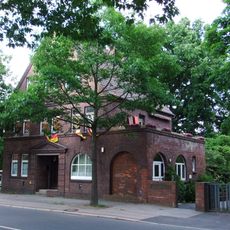
The cemetery lies on Weserstraße in Wulsdorf, south Bremerhaven. The main entrance is at the gardener's house built in 1919/20, which also served as a waiting hall, shop and public toilets. The chapel stands on the grounds; its lower floor housed the crematorium from 1930 until the last cremation on 17 April 1990.
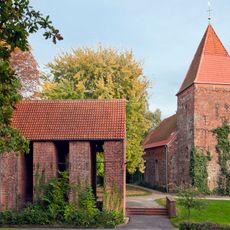
The brick pyramid on Feld 18e was built in 1919 for the dead of the First World War. Nearby, a memorial to the Mosel explosion records that 43 of the 83 victims are buried here; the attacker, William King Thomas, is said to lie elsewhere without a gravestone.
The community of curious travelers
AroundUs brings together thousands of curated places, local tips, and hidden gems, enriched daily by 93,811 contributors worldwide.