Amalienburg, Hunting lodge in Nymphenburg Palace Park, Germany
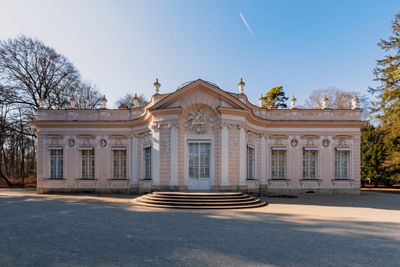
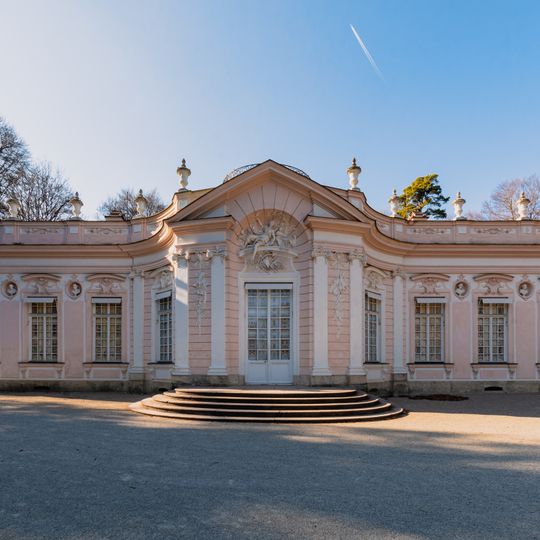
The Amalienburg is a single-storey Rococo hunting lodge in the Nymphenburg Palace Park, built 1734–1739 to designs by François de Cuvilliés. Its pale pink facade with white pilasters and trim curves outward on either side of a projecting central bay, which carries a sculpted pediment, a short balustrade and stone urns; the flat roofline also bears urns. A broad set of five shallow semi-circular stone steps leads to the tall glazed double door. Inside, the round Hall of Mirrors occupies most of the ground floor, its mirrored walls reflecting the park.
French architect François de Cuvilliés designed this pavilion between 1734 and 1739 for Elector Karl Albrecht and his wife Maria Amalia of Austria. The structure was created as a symbol of the power and prosperity of the Bavarian princely house during a period when such pleasure mansions were fashionable.
The pavilion takes its name from Electress Maria Amalia of Austria, wife of Karl Albrecht and a keen hunter. In the central niche of the eastern facade stands a stucco by Johann Baptist Zimmermann showing the hunting goddess Diana, which sets the theme carried through the rooms. The Blue Cabinet held the hunting guns in wall cupboards, with kennels for the dogs beneath.
The Amalienburg stands in the Nymphenburg Palace Park, not in the Residenz grounds; from the palace forecourt, paths lead west through the park to the pavilion. The interior is small, with the Hall of Mirrors, Rest Room, Blue Cabinet, Pheasant Room and kitchen opening off one another, so a visit takes little time. The kitchen keeps its Delft tiles and the 1735 Castrol stove.
The roof features a central platform that allowed hunters to observe and shoot pheasants from an elevated vantage point. This raised position made hunting here an unusual experience compared to typical hunting methods of the era.
The community of curious travelers
AroundUs brings together thousands of curated places, local tips, and hidden gems, enriched daily by 93,360 contributors worldwide.