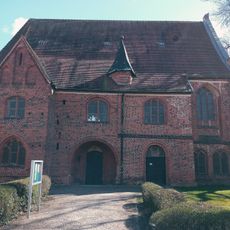
Uenglinger Tor, Medieval city gate in Stendal, Germany
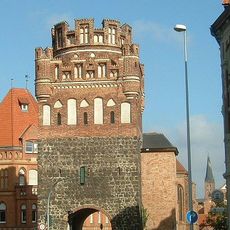
Uenglinger Tor is a brick Gothic gate tower about 27.5 metres high, with a square lower section of fieldstone and brick, a five-metre pointed-arch passage, four corner turrets, and a round upper storey topped by battlements. White shield-shaped plaster panels decorate the facade.
The lower section was built between 1288 and 1306 from fieldstone and brick when the St. Petri suburb was enclosed. Between 1450 and 1460 the tower gained its round top and corner turrets, likely by builder Steffen Boxthude. In 1792 the interior was to be converted into prison cells. Restored between 1815 and 1860, it has been a listed monument for over 200 years.
The gate's name comes from the village of Uenglingen to the west; records spell it Valva Ungeling in 1479 and Uengelingsches Tor in 1753. A local legend, retold by Hanns H. F. Schmidt in 1994, says the old master builder killed his pupil with a hammer after the pupil's Uenglinger gate outshone his own Tangermünder gate.
Since its restoration between 1983 and 1986, vehicles can no longer pass through the gate. The 27.5-metre tower is open again in summer, and its battlemented viewing platform gives a wide view over Stendal; entry and the climb are subject to a fee. A small pedestrian gate sits in the surviving stretch of town wall beside it.
The gate takes its name from the village of Uenglingen that lay to the west, indicating the direction it opened toward. This naming practice reveals how medieval city gates were often identified by their destination rather than a formal designation.
The community of curious travelers
AroundUs brings together thousands of curated places, local tips, and hidden gems, enriched daily by 94,020 contributors worldwide.