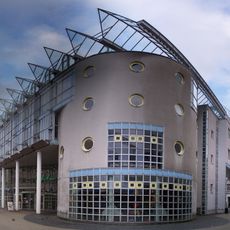
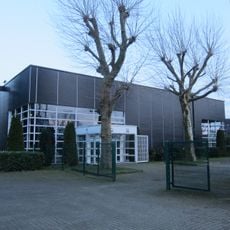
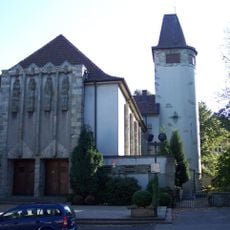
Westfälische Volkssternwarte, Public observatory in Westviertel, Recklinghausen, Germany.
The Westfälische Volkssternwarte is a public observatory in Recklinghausen offering opportunities to view celestial objects and learn about astronomy. The facility houses powerful telescopes that serve both casual visitors interested in the night sky and those pursuing serious astronomical observation.
In 1940 surveyor Vinzenz Dahlkamp proposed a public observatory, and the city granted 35,000 Reichsmark to raise an octagonal tower in the Hindenburgpark. After the war, a new association built the four-metre Uraniatempel in 1950; the main building opened on 13 October 1953 with a 28 cm Newtonian telescope. A Zeiss planetarium followed in 1966, and a ground-floor lecture hall was added in 2017.
The observatory is run by the city of Recklinghausen and holds regular public viewings of the night sky and the Sun. Its lecture hall and planetarium, equipped with a Carl Zeiss ZKP2 Skymaster projector, run a broad programme. Outside, a "field of the senses" offers experiments on optical and acoustic perception, and the start of a roughly 3 km planet trail.
The observatory stands in the Stadtgarten near the Ruhrfestspielhaus, in the northwest of Recklinghausen. Public sky and solar observations are held regularly; the lecture hall and planetarium run their own programme. A ground-level extension with a new lecture hall and step-free access opened on 3 June 2017. Outdoors, a 3 km planet trail begins on the grounds.
The observatory's 1999 project of horizontal astronomy led to the building of a large sundial on the nearby Halde Hoheward in 2005 and a horizontal observatory there in 2008. The site also marks the start of a roughly 3 km planet trail, and an "Erlebnisfeld der Sinne" outside holds experiments on optical and acoustic perception.
The community of curious travelers
AroundUs brings together thousands of curated places, local tips, and hidden gems, enriched daily by 94,444 contributors worldwide.