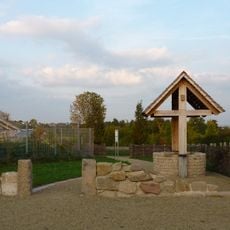
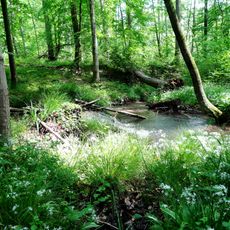
Weißer Steinbruch, Natural monument and quarry in Pfaffenhofen, Germany.
The Weißer Steinbruch is a geotope and natural monument that displays sandstone cliffs and clay deposits arranged in multiple layers across a ridge formation. Visitors can see various minerals and rock types exposed in the open cliff face.
The quarry was worked only from 1902 to 1914, extracting Stubensandstein as building material. In 1906 its tenant Albert Burrer gave Eberhard Fraas an aetosaur torso for the Royal Stuttgart Naturalienkabinett, the first find to enter a collection. The site has been a natural monument since 1986.
The quarry is a protected geotope and natural monument, designated as such in 1986. Its name, Weißer Steinbruch (White Quarry), refers to the pale Stubensandstein extracted here. Visitors can examine the sandstone beds and the clay layers between them, where the fossils were found.
The observation platform offers good views across the surrounding landscape, especially on clear days. Information boards at the edge explain what visitors can see in the exposed rocks.
The first find reached Stuttgart's Royal Naturalienkabinett in 1906, when tenant Albert Burrer gave Eberhard Fraas a fragment of an aetosaur's body. The quarry also yielded the holotype of the predatory dinosaur Procompsognathus and remains of Sellosaurus, now called Plateosaurus gracilis, one of Europe's oldest land dinosaurs.
The community of curious travelers
AroundUs brings together thousands of curated places, local tips, and hidden gems, enriched daily by 93,787 contributors worldwide.