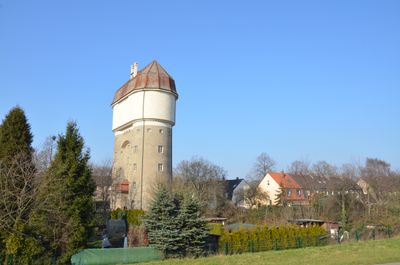
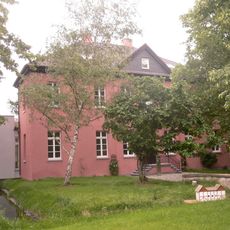
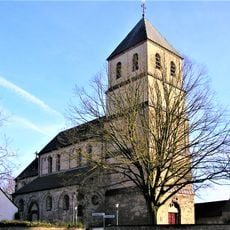
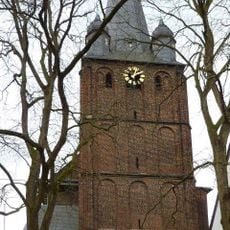
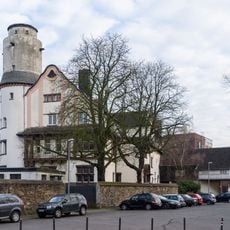
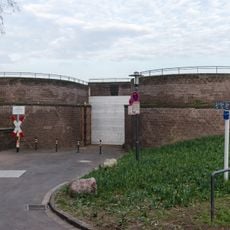
Wasserturm Hohenbudberg, Water tower in Hohenbudberg district, Duisburg, Germany.
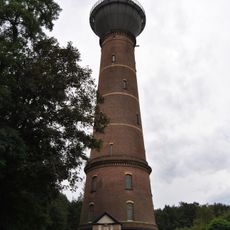
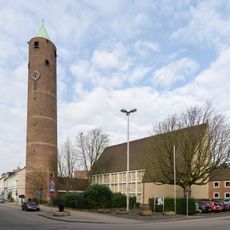
Wasserturm Hohenbudberg is a 35-metre double water tower built in 1916 at the border of Duisburg-Friemersheim and Krefeld-Hohenbudberg. Two reinforced-concrete tanks of 500 cubic metres each sit side by side in the upper third, resting on two round shafts of brick masonry; the roof is also reinforced concrete, and its low pitch with beaver-tail tiles echoes the neighbouring railway settlement.
The Prussian railway administration built the tower in 1916 to supply water to steam locomotives at the nearby Hohenbudberg marshalling yard. It was planned in 1915 by the Munich architects and contractors Gebrüder Rank, who also included six workers' flats. It remained in service until 1964, survived the Second World War largely undamaged, and was listed as a technical monument in 1985.
The tower's name comes from the Hohenbudberg marshalling yard it supplied; the adjacent railway settlement for officials and workers is itself protected as a coherent ensemble. The former pump and switch rooms later housed a pub and then artists' studios, and the building is now a private residence.
The structure is accessible as part of walking routes through the industrial area and can be viewed from the outside. It works well as a stop on a walk through the Ruhr Valley, where several similar buildings stand nearby for comparison.
The double reservoir design is rare: two 500-cubic-metre reinforced concrete tanks sit side by side in one building, so supply continued during cleaning or repairs. Photographers Bernd and Hilla Becher recorded the tower from the late 1950s in their European survey of industrial monuments.
The community of curious travelers
AroundUs brings together thousands of curated places, local tips, and hidden gems, enriched daily by 94,383 contributors worldwide.