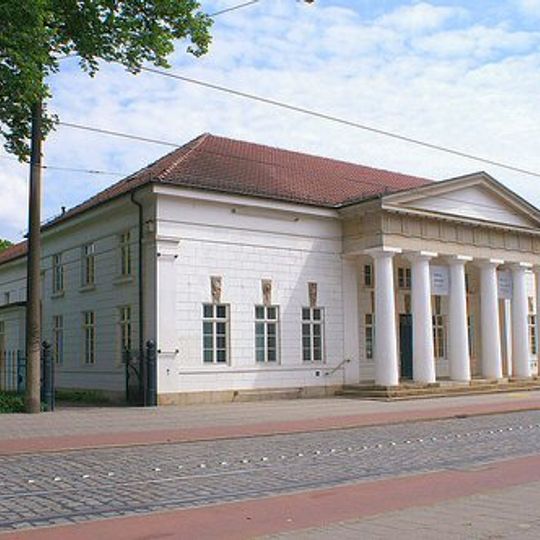
Wilhelm Wagenfeld House, Design museum in Germany
The Wilhelm Wagenfeld House is a design museum in Bremen dedicated to the life and work of industrial designer Wilhelm Wagenfeld. The building displays his designs for furniture, lamps, and everyday objects, along with his personal working style.
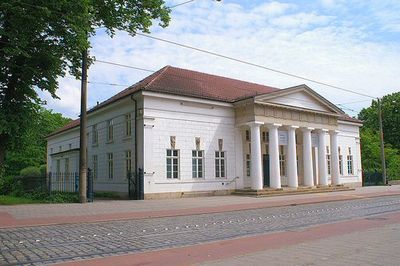
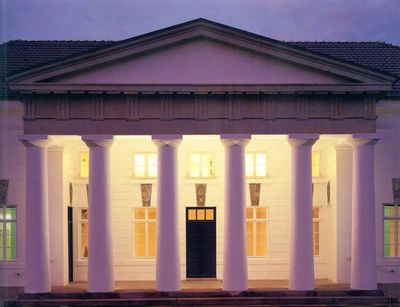
Built in the Neoclassical style and completed in 1828, the building was designed by Friedrich Moritz Stamm as the Detentionshaus, part of the Ostertorwache, and served as a prison and police station; the Gestapo used it from 1933. Police left in 1966, after which it became an exhibition centre and office building. It now bears the name of Bremen-born designer Wilhelm Wagenfeld (1900–1990), whose foundation has offices here and whose archives have been open to the public since 1999.
The building is named after Bremen-born designer Wilhelm Wagenfeld (1900–1990), whose household objects are shown alongside temporary design exhibitions. Since 1999 the Ostertorwache archives have been open to the public, tracing the building's use as a prison, including by the Gestapo from 1933. The Wilhelm Wagenfeld Foundation has its offices here.
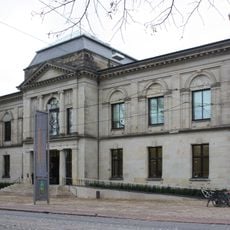
The building stands in Bremen's Old Town, close to the Kunsthalle Bremen art museum, and is shared with the offices of the Wagenfeld Foundation. The Ostertorwache archives on its history as a prison, including its use by the Gestapo from 1933, have been open to the public since 1999. Look for the military reliefs by Heinrich Frese, completed in 1973, on the windows at the front and rear.
Wagenfeld's lamp designs are considered classics of industrial form and are still collected by museums worldwide. His work demonstrates how functional design can unite beauty with practicality.
The community of curious travelers
AroundUs brings together thousands of curated places, local tips, and hidden gems, enriched daily by 93,705 contributors worldwide.