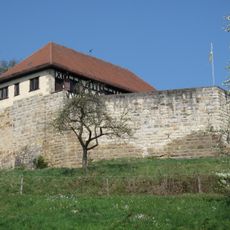
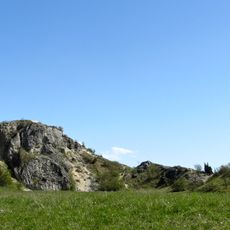
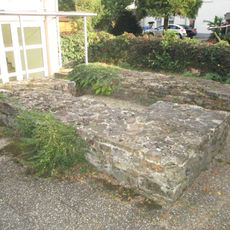
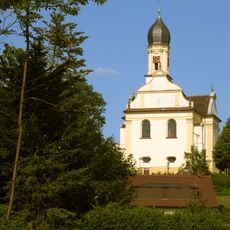
Burgstall Burren, Medieval castle ruins in Wäschenbeuren, Germany
Burgstall Burren is a medieval castle ruin near Wäschenbeuren whose remains were revealed through excavations in 1957. The site shows the foundations of an early residential tower alongside traces of a larger structure built several centuries later.
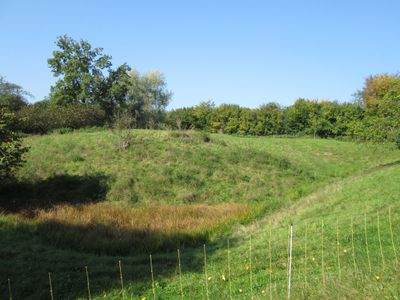
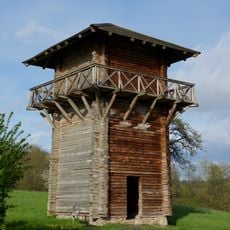
A 1957 excavation found the foundation of a square Romanesque residential tower, probably built in the first half of the 11th century, with walls 1.5 metres thick and an interior of 25 square metres. In the Gothic period it was replaced by a new tower with thinner walls and a slightly larger interior; the ditch, still partly 3 metres deep, was dug and the mound raised to 18 by 18 metres. In the mid-18th century the Württemberg Obervogt Sailer had a building erected here, sold for demolition in 1861.
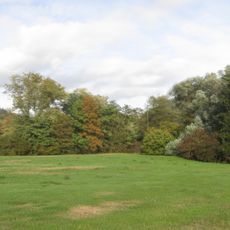
The name Burren refers to the flat meadow knoll where the tower hill lies, in the Burglauch field west of Wäschenbeuren. The site is linked in local tradition to the Staufers, but the 1957 excavation found no trace of a Staufer main seat. The plot, Flurstück 1600, belongs to the Catholic parish of Wäschenbeuren and is used for keeping sheep.
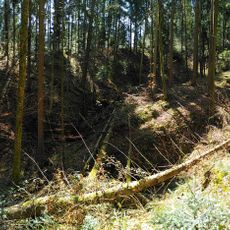
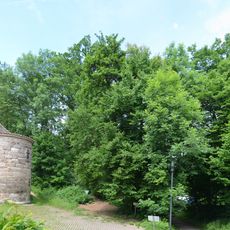
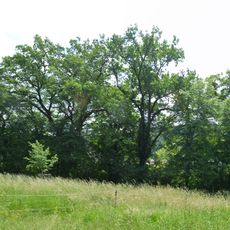
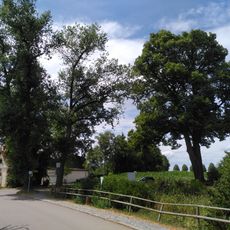
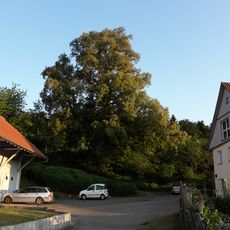
The site lies on a flat meadow knoll about 600 metres west of the Wäscherburg, next to a water tower, in the Burglauch area. The plot belongs to the Catholic parish of Wäschenbeuren and is used for grazing sheep, so expect open pasture rather than a maintained ruin. The tower hill and its partly three-metre-deep moat are visible as low earthworks.
The castle grounds were surrounded by a shallow ditch that served more as a boundary line than as a defensive barrier. This modest feature reveals that not every medieval fortress needed impressive fortifications to fulfill its purpose.
The community of curious travelers
AroundUs brings together thousands of curated places, local tips, and hidden gems, enriched daily by 94,532 contributors worldwide.