Barbarossakirche St. Jakobus, church building in Hohenstaufen, Göppingen, Germany
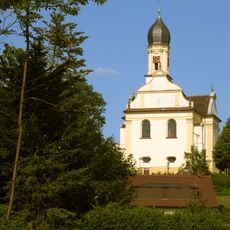
The Barbarossakirche St. Jakobus is a late 15th-century church in Hohenstaufen, built where an earlier place of worship probably stood. Its west facade carries the coats of arms of the Staufen territories, ministerialis families and seven electors, added from 1859 when the church was remodelled as a national historical monument.
An earlier place of worship occupied this site before the current church was built in the late 15th century. From 1859 onward, it was transformed to honor the Hohenstaufen dynasty and Emperor Frederick I Barbarossa, after local priest Eduard Keller founded a movement to preserve this regional heritage.
The church was originally named St. Jakob; it took the name Barbarossakirche only after 1859, when pastor Eduard Keller's Hohenstaufenverein remodelled it as a national history monument. The west facade carries the coats of arms of the Staufen territories, ministerial families and seven electors, added in that campaign.
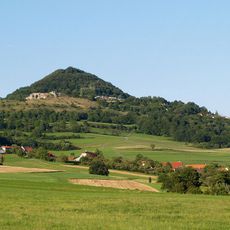
The church stands in the Hohenstaufen district of Göppingen, below the Hohenstaufen castle hill. The west facade with the coats of arms faces the visitor from outside; the interior is not open to visitors. The building belongs to the Protestant parish of Hohenstaufen in the Geislingen-Göppingen church district.
A stained glass window depicts two scenes: soldiers with modern weapons arresting Jesus in the Garden of Gethsemane, while another section shows a simple church community caring for one another. This window was created by artist Walter Kohler, who often reflected current events and faith in his religious artworks.
The community of curious travelers
AroundUs brings together thousands of curated places, local tips, and hidden gems, enriched daily by 94,532 contributors worldwide.