Steinsberg, Mountain summit in Kraichgau region, Baden-Württemberg, Germany.
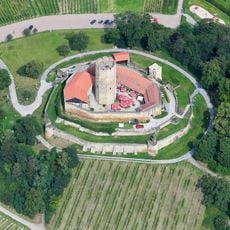
Steinsberg is a 333.4 m high volcanic cone near Weiler, a district of Sinsheim in the Kraichgau. Its summit is crowned by Steinsberg Castle, and its slopes show the red colour of the Lower Bunter Mergel. The hill is the highest elevation in the northern Kraichgau.
Steinsberg is the eroded stump of a volcano active about 55 million years ago in the Paleogene. Its conduit filled with hard nephelin-basanite, which resisted erosion better than the surrounding rock, leaving the cone-shaped hill. The surrounding Upper Keuper and Jurassic layers have since been worn away, and the slopes expose the red Lower Buntsandstein marl.
The village of Weiler at the southern and western foot of the mountain, now part of Sinsheim, has long been shaped by agriculture and winegrowing. Vines still stand on the steep slopes from northwest to east, and the name Steinsberg refers to the rocky volcanic cone beneath the castle.
The summit is reached on foot; the steepest drop is to the north, where the slope falls over 170 m in the first 1.8 km toward the Ilvesbach, so approaches from Sinsheim, about 4 km north, are the most direct. The village of Weiler lies at the south and west foot, with vineyards on the north-west to east slopes. Exposed nepheline basanite can be seen right before the castle gate and at the round tower inside the castle.
The summit is a volcanic neck of nephelin-basanite, a hard rock that resisted erosion after the surrounding Upper Keuper and Jurassic layers wore away. The rock is visible right before the castle gate and at the round tower inside the castle.
The community of curious travelers
AroundUs brings together thousands of curated places, local tips, and hidden gems, enriched daily by 94,225 contributors worldwide.