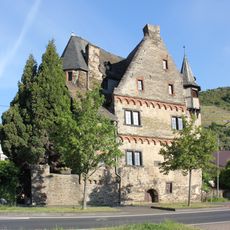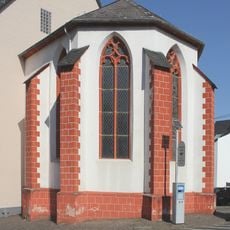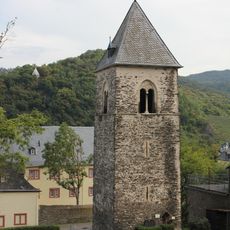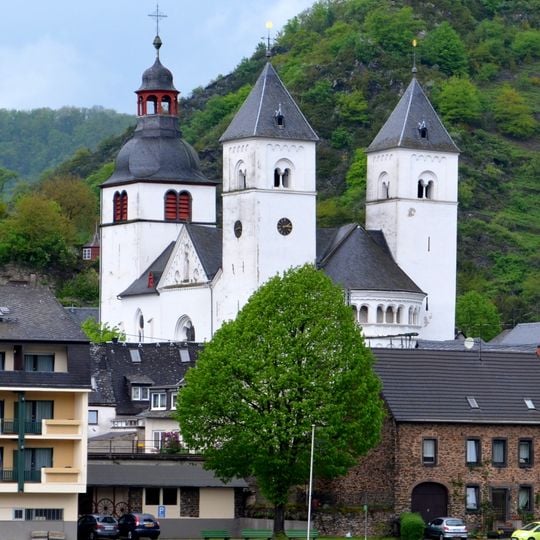
St. Castor, Romanesque parish church in Treis-Karden, Germany.
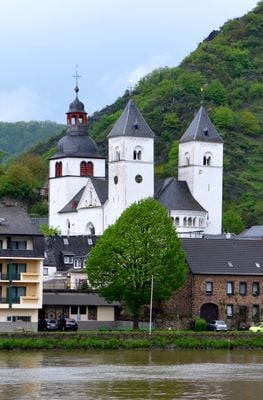
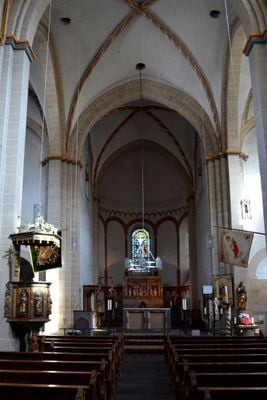
St. Castor is a Romanesque parish church in Treis-Karden, a small town along the Moselle River in Germany. It has thick stone walls, rounded arches, and two white towers that stand out above the surrounding rooftops.
A Romanesque basilica replaced a Carolingian church on this site; construction of the choir with apse, flanking towers and transept began in 1183 (or 1186 in some accounts). The nave followed with early Gothic features, and the west tower's first five storeys date to around 1120, with its bell storey added in 1699. The collegiate foundation was dissolved in 1802.
The church is dedicated to Castor of Karden, a priest who worked here around 400. His Gothic shrine, restored in the 19th century, stands in a wrought-iron tomb made by Felix Vallendar in 1954 in a side chapel of the north choir tower. On his feast day, 13 February, the shrine is carried through the church in procession; a 1790 document records that it was once held up so believers could pass beneath it with bowed heads.
The church stands close to the Moselle riverbank and is easy to reach on foot along the riverside paths. A small museum in the adjacent building on St. Castor-Strasse displays finds from different periods and is worth a short visit.
The church keeps a 15th-century wooden shrine for Castor of Karden, restored in the 19th century and set in an open wrought-iron tomb made by Felix Vallendar in 1954. On his feast day, 13 February, the shrine is carried through the church in procession. A 1790 document records that it was once held up so believers could pass beneath it with bowed heads.
The community of curious travelers
AroundUs brings together thousands of curated places, local tips, and hidden gems, enriched daily by 92,681 contributors worldwide.