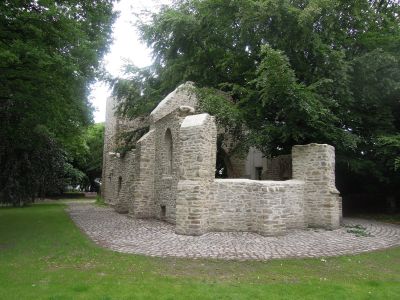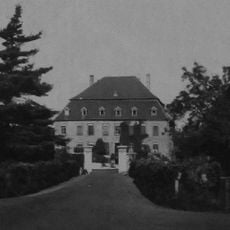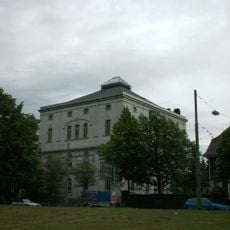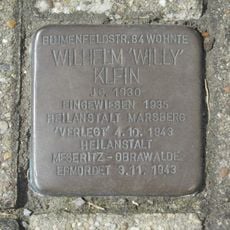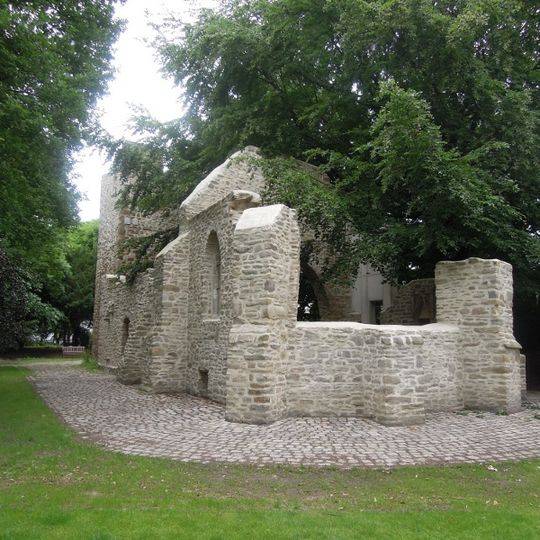
Sylvesterkapelle, Medieval chapel ruins in Weitmar, Bochum, Germany.
The Sylvesterkapelle is a medieval chapel ruin within Weitmar Castle Park whose remaining outer walls display Romanesque and Gothic features. The structure consists primarily of masonry that suggests the original size and form of the building.
The chapel was first mentioned in a document in 1397 and probably dates from the early 13th century. In 1471 Pastor Johann von Hasenkamp raised it to an independent parish church. It became Lutheran in 1543, and after decay in the 18th and 19th centuries the congregation built the Matthäuskirche elsewhere in 1866–1868. The often-repeated claim that it was destroyed by bombs is false.
The chapel is named after Pope Sylvester I. In 1471 Johann von Hasenkamp raised it to an independent parish church on the Feast of Saint Lawrence (10 August). A branch of the Hasenkamp family remained Catholic and built a separate chapel on the Schlossplatz in 1748. About ten gravestones remain in the small churchyard beside the chapel, one of the last burials there took place in 1874.
The ruin is located within Weitmar Castle Park and is accessible via several hiking trails that wind through the grounds. Visitors should wear sturdy footwear since the ground can be uneven and the ruin is protected heritage.
The claim that bombs destroyed the chapel is a persistent error: the wartime damage hit the private chapel of Haus Weitmar, not this building, which had already decayed in the 18th and 19th centuries. Since 2012 two steel blocks by Richard Serra, the installation O.I.C, stand in the ruin, and the crypt uncovered in 2016 holds William Tucker's sculpture Prow behind a glass door.
The community of curious travelers
AroundUs brings together thousands of curated places, local tips, and hidden gems, enriched daily by 93,442 contributors worldwide.