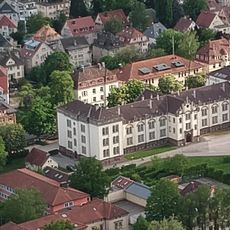
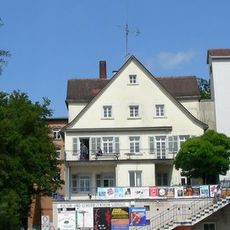
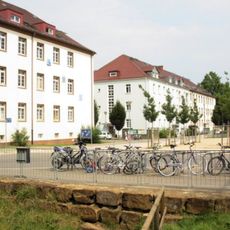
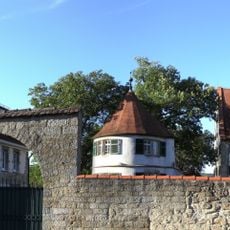
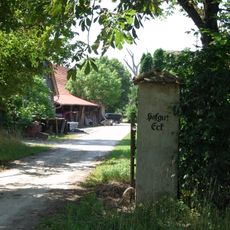
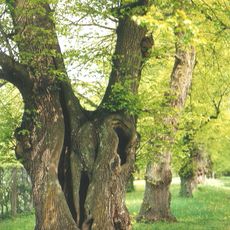
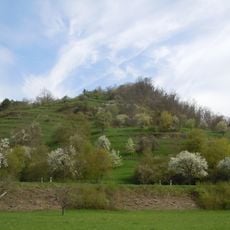
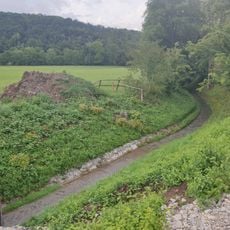
Kreßbach, Baroque castle in Tübingen, Germany.
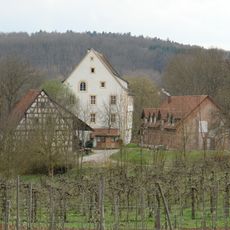
Schloss Kreßbach is a rectangular building with a hipped roof, built in 1766/67 for the Freiherren von Saint-André. It has a flat entrance risalit and a projecting portico with Tuscan columns. The adjoining outbuildings date from the 17th and 18th centuries.
Schloss Kreßbach was built in 1766/67 for the Freiherren von Saint-André as a rectangular building with a Krüppelwalmdach. The outbuildings date from the 17th and 18th centuries. During the Second World War the Landes-Luftschutzschule was housed in the castle.
The village churchyard holds a burial chapel and a half-timbered house, remnants of the former cemetery that stood beside the castle. The Rococo fountain in the castle garden survives from the building period of 1766/67, when the Freiherren von Saint-André had the estate laid out.
Schloss Kreßbach stands in the village of Kreßbach, part of the Weilheim district of Tübingen, southwest of the city centre. The site is reached by road through Weilheim; the surrounding hamlet is small, so plan the visit together with the wider Tübingen area.
The Schloss served as a Landes-Luftschutzschule (regional air-raid protection school) during the Second World War, a use that left little trace in the building's outward appearance. Today it houses the headquarters of the Deutsche Knochenmarkspenderdatei, the German bone marrow donor registry.
The community of curious travelers
AroundUs brings together thousands of curated places, local tips, and hidden gems, enriched daily by 92,780 contributors worldwide.