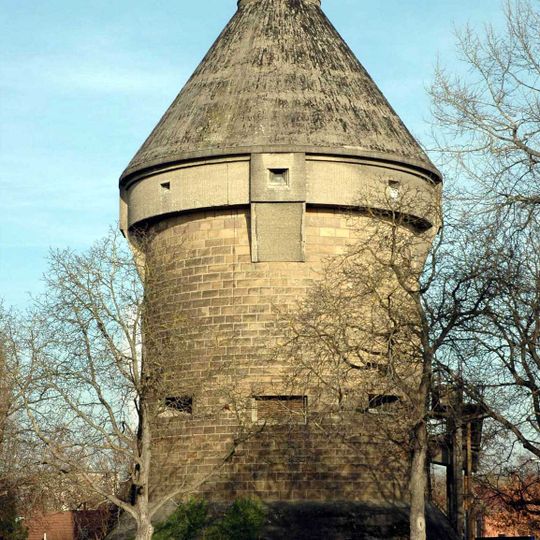
Theresienturm, Air-raid shelter tower in Heilbronn, Germany
The Theresienturm is a 28.5-metre-high high-rise bunker on the Theresienwiese, tapering from 12 to 11 metres in diameter. Its natural-stone-clad outer walls are about 1.40 metres thick and the flat cylindrical roof 2 metres. Inside are ten storeys of roughly 2 metres each, six of them with round crew rooms for 42 people, linked by a spiral corridor along the outer wall instead of stairs.
Built in 1940 by Dyckerhoff & Widmann for the Reich Air Ministry, the tower was named General-Wever-Turm after Luftwaffe chief of staff Walther Wever, who died in 1936. It was one of only three new bunkers in Heilbronn and survived the air raids almost undamaged. In 2016 the city council renamed it Theresienturm after the adjacent Theresienwiese.
The tower's name changed in 2016: the city council renamed it Theresienturm after the adjacent Theresienwiese, distancing it from General Walther Wever, the Luftwaffe chief of staff it had honoured since 1940. Visitors can still see the circular crew rooms for 42 people and the spiral corridor along the outer wall, built for rapid occupation during alerts.
Access to the tower is only by guided tour, which can be arranged through the Heilbronn Tourist Information office with small group sizes. It is best to contact the tourist office in advance to reserve a spot and learn about available times.
The tower was planned for military use, but no weapons were ever installed in it; the third-floor openings were intended as a gun position that stayed empty. Its high entrance, reached by a ramp from the flood dam at the slaughterhouse, also kept the door above the Neckar's flood plain. From 1963 to the late 1980s a large illuminated MAN advertisement stood on the tower, which is why it was sometimes called the MAN-Turm.
The community of curious travelers
AroundUs brings together thousands of curated places, local tips, and hidden gems, enriched daily by 92,688 contributors worldwide.